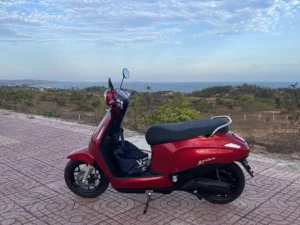
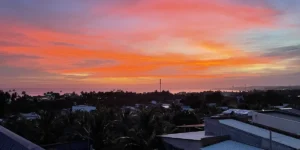
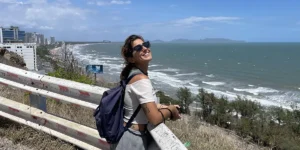
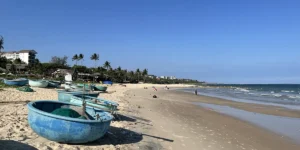
Located on the southeast coast of Vietnam, Mui Ne is a vibrant coastal ward of Phan Thiet city. While the area is famous for its unique microclimate and the steady winds of the South China Sea that draw kitesurfers from around the world, most general travelers see only a fraction of what’s here.
Mui Ne’s tourism revolves around a short list. Red dunes, white dunes, Fairy Stream, and the fishing village cover most itineraries. These spots are iconic, but they often feel like a “tourist bubble.”
Beyond that circuit, though, most visitors rarely wander. The six hidden gems in Mui Ne below sit within a short motorbike ride of the main strip, yet they attract mostly locals. None are gated or ticketed as tourist sites, offering a glimpse into the authentic daily life and rugged geography of the Phan Thiet coastline that remains invisible to the resort crowds.
This guide covers six Mui Ne hidden gems most travelers miss, from secluded cliffside shrines to elevated wind turbine viewpoints. Based on multiple visits across different seasons and ground-updated in April 2026, it provides the precise logistics and local hints needed to find the quiet side of the coast. Use these insights to bypass the crowds and discover the region’s authentic character.
You can find more advice for your trip in our things to do in Mui Ne guide.
Locations marked with 📍 open directly on Google Maps.
Table of Contents
1. Wind Turbine Viewpoints Above Mui Ne
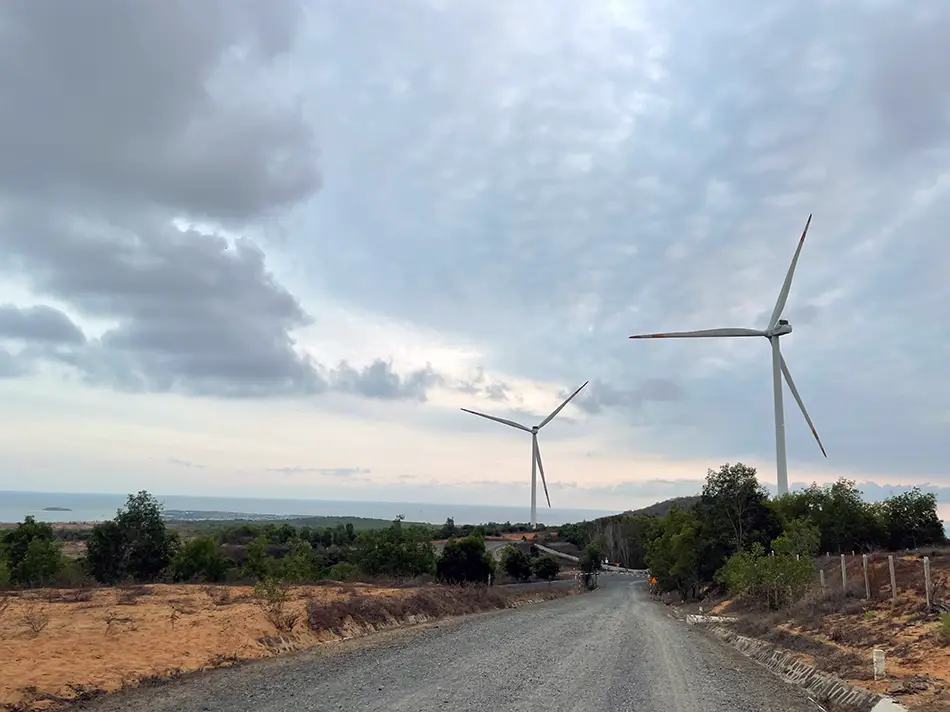
A cluster of wind turbines stands on the hills directly above Mui Ne, overlooking the town. This site is entirely informal, with no signs, designated parking, or ticket booths. It functions more as an open landscape than a traditional tourist attraction.
The area is accessible via wide service roads built to maintain the turbines. While these roads are broad and easy to follow, they are unpaved and covered in loose gravel, so they require careful motorbike handling.
The experience here is less about reaching a specific observation deck and more about the ride itself. You can follow these gravel paths between the generators to find your own vantage point. Because the terrain is open and elevated, you can find views in every direction.
From various points on the hills, you can see the Hon Rom Cape curving into the sea, the dense rooftops and kite beaches of Mui Ne, a small offshore island, and the silhouette of Ta Cu Mountain rising in the distance inland.
The drive toward the hills passes through local neighborhoods that look nothing like the beach strip. This area definitely belongs in a Mui Ne itinerary for those who love to drive around and see the local life. Small gardens line the road, and the houses belong to fishing families who live here year-round.
Practical: Free. No fixed hours, since the hillside is public land. Easiest reached by motorbike. No shade, food, or water on-site.
2. Ba Vang Shrine (Miếu Bà Vàng)
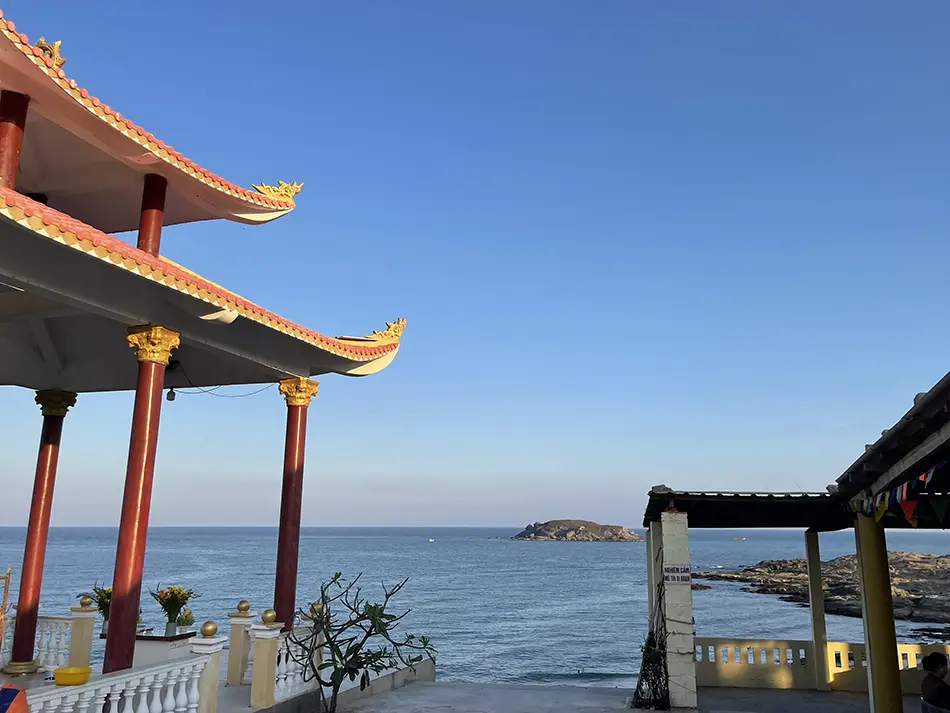
Ba Vang Shrine is a small sanctuary located on a cliffside past the fishing village, set back from the main coastal road. Local fishing families maintain the site, which is dedicated to a Cham princess and serves as a place of prayer for those working at sea. A light blue statue of Quan Am (the Goddess of Mercy) stands on the grounds, facing the water.
The shrine sits on a patch of open land overlooking a rocky shoreline. From the platform, you can see the stone formations below and a small offshore island. The building itself is modest, containing a simple incense altar and space for local offerings. Because it is away from the main traffic areas, the site remains quiet throughout the day. Visitors typically stop for a short time to see the statue and the coast before continuing toward the end of the cape.
Practical: Free, open access. Reached via a small turn-off; a motorbike is the most practical way to find the path. The shrine is an active site for prayer and offerings.
3. Muine Rocks Sunset Point
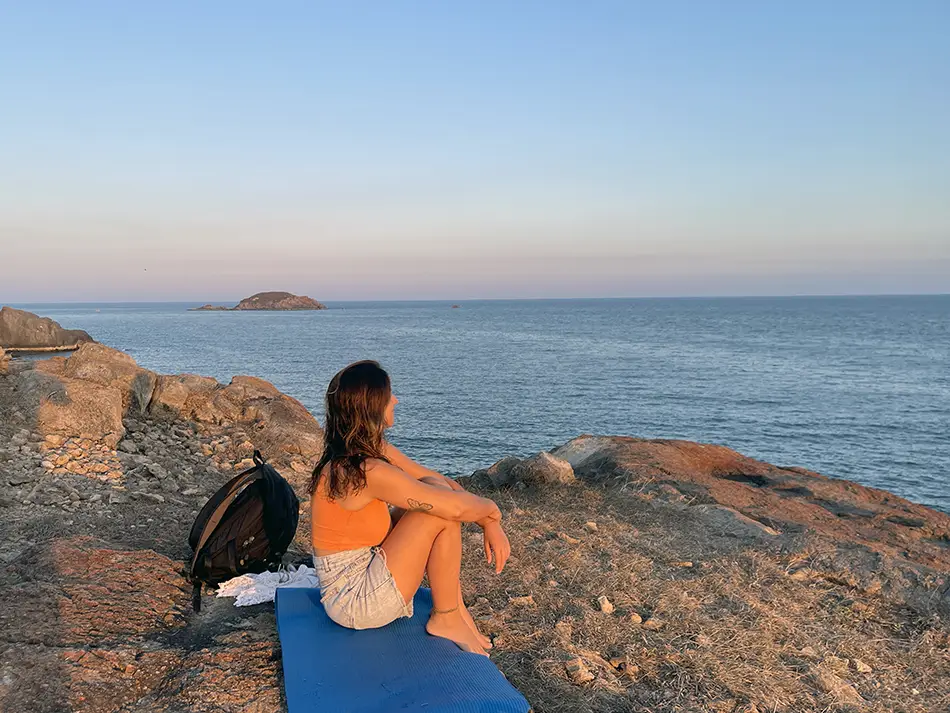
Past Ba Vang Shrine, the land narrows into a rocky promontory that ends in natural rock platforms. Locals call this spot Muine Rocks Sunset Point. Unlike the better-known sunset spots along the main beach, this cape has no cafés, no vendors, and no signage.
From the shrine, a footpath tracks along the headland toward the tip of the promontory. The rocks at the end are arranged almost like natural seating, and they face directly into the sunset. Sightlines also run back along the beach toward town.
On weekends, local families sometimes ride partway along the path by motorbike and set up picnics at a midpoint. However, the cape itself stays quiet almost every day. After dark, the path back runs unlit and uneven, so a flashlight or phone light becomes useful.
For the more popular sunset spots along the main beach, see our Mui Ne sunset spots guide.
Practical: Free, open 24/7. Reachable on foot from Ba Vang Shrine in about 10 minutes.
4. Fish Sauce Museum (Làng Chài Xưa)
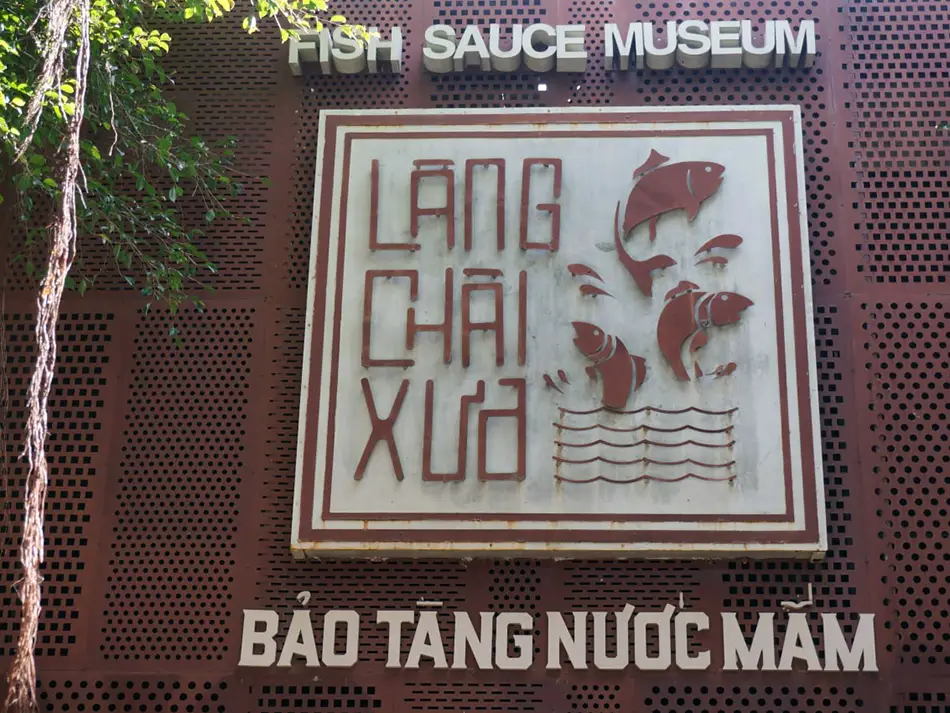
Fish sauce (nước mắm) has been produced in Phan Thiet for roughly 300 years, and the town remains one of Vietnam’s main production centers. The Fish Sauce Museum, known locally as Làng Chài Xưa, opened in 2018 as the country’s first museum dedicated to the subject. It sits directly on the main Phan Thiet–Mui Ne road. Yet most foreign visitors pass it without noticing.
The exhibits cover the full arc of the craft. Old wooden fermentation vats anchor one section. Traditional fishing gear and Champa-era artifacts tied to the region’s coastal history fill another, and reconstructions of 19th- and early-20th-century fishing village life take up the rest.
The museum spans roughly 21,500 square feet (2,000 m²). Displays are lit for atmosphere rather than brightness. Most visits run between 45 minutes and an hour and a half. It rewards visitors who care about food history or Vietnamese culture.
Practical: Entry 100,000 VND ($3.8/€3.3) per adult. Children under 3 ft 3 in (1 m) enter free. Open daily 9 a.m.–6 p.m. Address: 360 Nguyễn Thông, Phú Hài, Phan Thiết.
5. Gai Garden Coffee
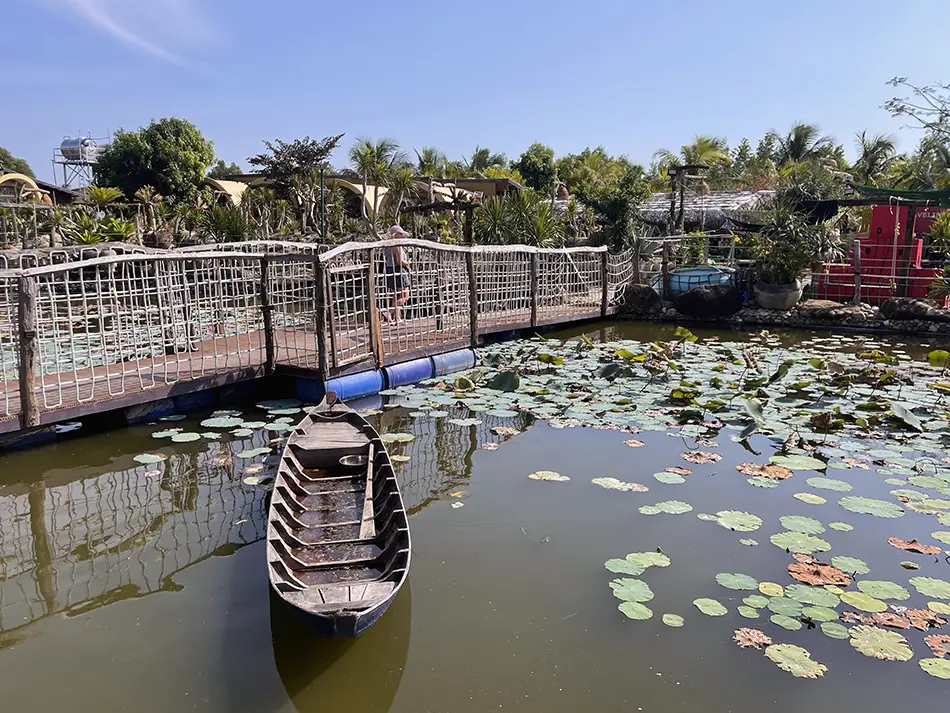
Gai Garden is a sprawling café located off the main tourist strip in the Thien Nghiep area. The owner has spent years developing the property, which is known for its extensive collection of cacti. The grounds are divided into several sections, including an area for succulents, a pond with a small wooden boat, and various outdoor paths.
The layout is spacious enough that tables are spread out across different zones, each with its own visual character. Some seating is tucked into stylized pavilions, while other tables sit directly under trees for natural shade. The menu covers standard Vietnamese and Western drinks — coffee, tea, and smoothies — along with a limited food selection.
It is a quiet, slow-paced spot where most visitors stay for an hour or two. A popular order here is the ginger tea with honey, served in a teapot.
Practical: Free entry; pay per order. Address: 20 Trần Bình Trọng, Thiện Nghiệp, Phan Thiết. Reachable by taxi or motorbike.
6. Thien Quang Temple (Chùa Thiện Quang)
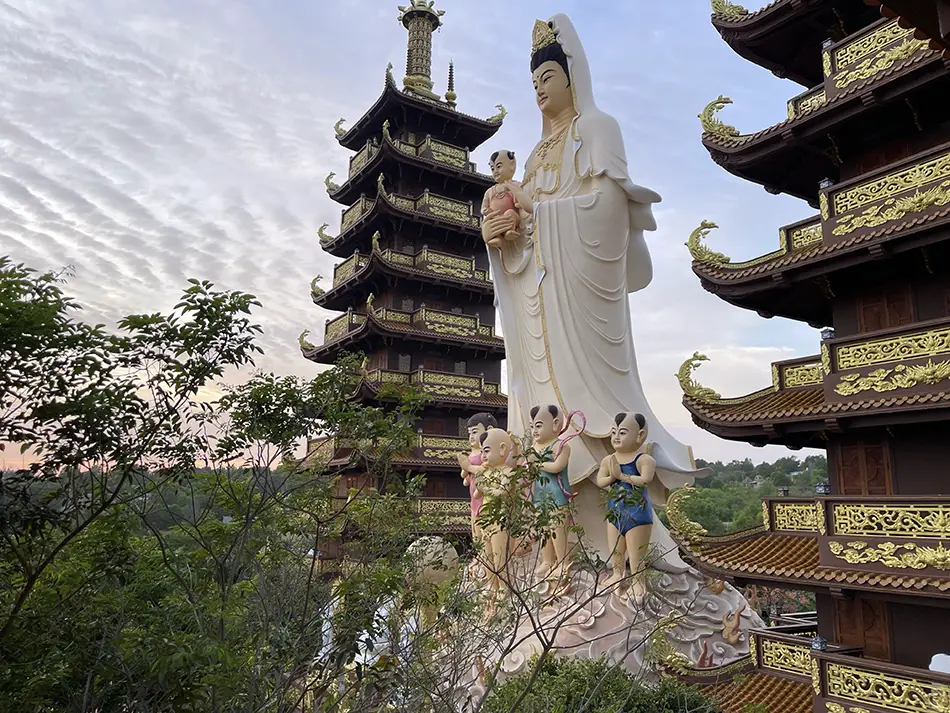
Located in the hills north of Mui Ne, Thien Quang is an active Buddhist temple serving the local community. The complex features a multi-story main hall, a large statue of the Goddess of Mercy, and two tall towers added during recent expansions. It is a quiet, functioning site that remains relatively unknown to most travelers.
On most days, the grounds are nearly empty, and the meditation rooms remain open to those seeking a quiet space to sit. The temple is accessible even if you aren’t dressed for the occasion; monks provide simple robes at the entrance to ensure visitors meet the dress code. For the best views, head to the upper-floor balcony of the main hall, which overlooks the surrounding countryside and catches the late afternoon sun.
The experience is best timed for the mid-afternoon. Starting around 3 p.m., an informal market pops up along the approach road, where local farmers and fishermen sell their goods — the kind of off-strip food spot we list more of in our backpacking Mui Ne guide.
Since Thien Quang sits in the same elevated area as the wind turbines, both locations can be easily combined into a single motorbike loop.
Practical: Free entry; open during daylight hours. Robes are available at the entrance. The site becomes significantly busier on the 1st and 15th of each lunar month due to traditional offerings. The towers are closed to the public.
Final Thoughts
The character of Mui Ne shifts quickly once you move a few hundred meters off the main resort roads. Whether it is the quiet of Thien Quang at sunset or the afternoon bustle of a roadside market, these locations offer a version of the coast that stays consistent throughout the year.
Most of these spots are easy to reach on a standard motorbike loop, allowing you to leave the busy tourist zones behind in minutes. Exploring at a slower pace helps in finding those parts of the region that still retain their authentic local feel.