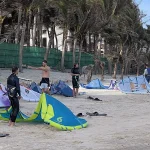



Mui Ne is the mecca of Vietnamese kitesurfing. This coastal village draws sports enthusiasts from across the globe during the winter months when the wind is at its most consistent and reliable. While seasoned pros love this location for many reasons, this article is dedicated to those of you just planning to dive into this incredibly addictive sport and considering kitesurfing lessons in Mui Ne.
To give you the most in-depth perspective, we’ve invited the owner of the K1 Kiteschool as a co-author. These guys are our official sustainable partners in the region. Beyond teaching, they’ve taken responsibility for their stretch of beach, keeping it clear of debris. But as always, we guarantee no fluff—just the essentials.
Meet Sergio: kitesurf instructor, and a good friend of ours. He’s here to tell you everything you need to know before deciding if Mui Ne is the right place for your first tack.
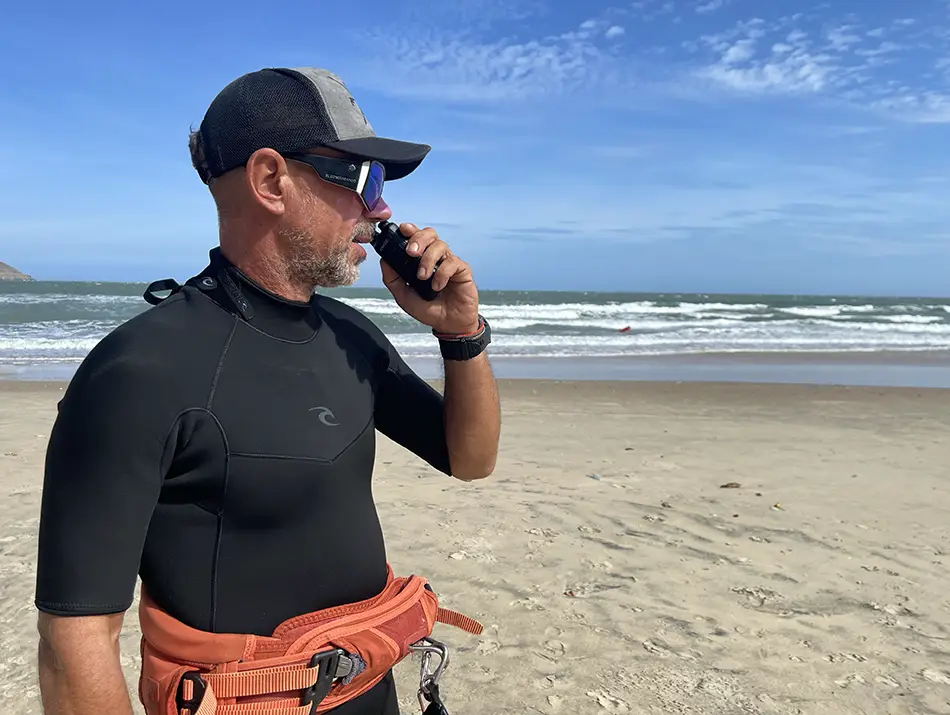
Aloha, friends! In this article, I’ll walk you through the specifics of learning to kitesurf in Mui Ne: the good, the bad, and how it stacks up against other spots in Southeast Asia.
We’ll cover the two main locations, including the City Beach and the Wave Spot, along with how long it actually takes to get riding and exactly what this pleasure will cost you.
What exactly is kitesurfing?
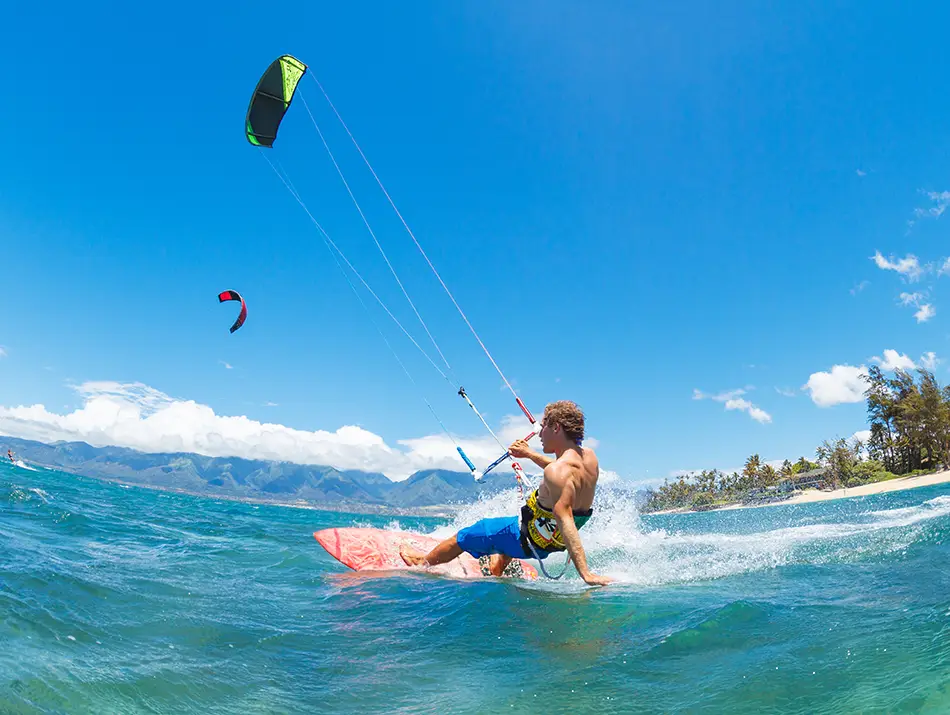
If you’re already looking for kitesurfing lessons in Mui Ne, you likely have an idea of what the sport is. But for those who’ve seen it and want in without fully grasping the mechanics: Kitesurfing (or kiteboarding) is a sport where all movement is generated by the wind. You’re attached to an inflatable kite via a waist harness, standing on a board with footstraps.
The kite is the core of the sport. But once you master the basics, the boards offer incredible freedom of expression.
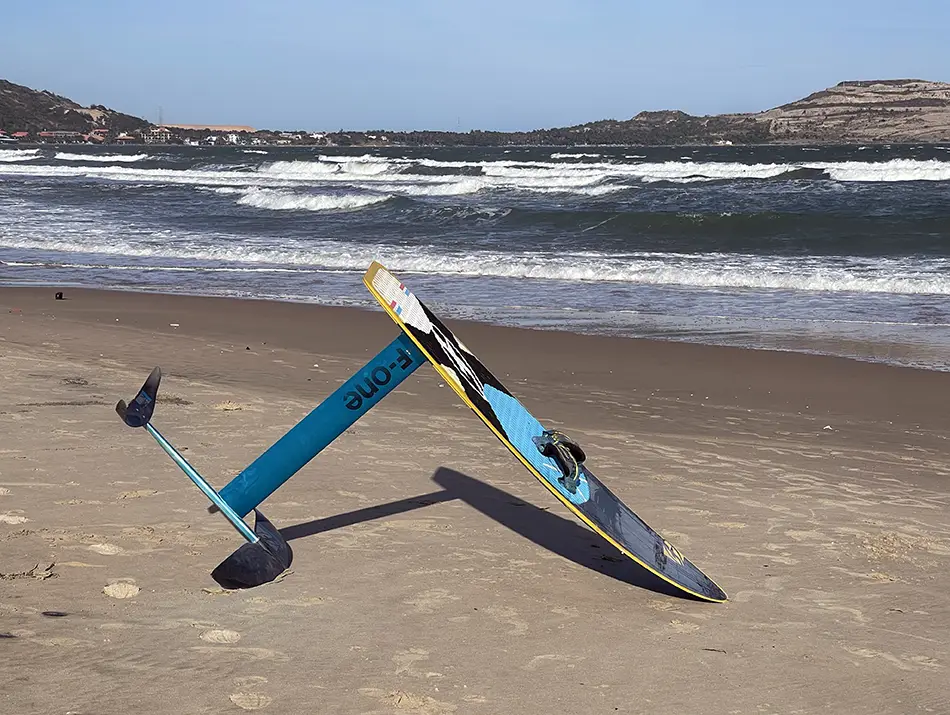
- Twin Tip: This is what you’ll learn on. It’s a symmetrical, bidirectional board. It’s the go-to for beginners and remains the primary gear for those into high jumps and freestyle.
- Directional (Surf) Board: Not mandatory, but a dream for those who crave waves but hate “paddling like a seal” at the lineup. You use the kite to catch the wave, then focus entirely on the surf. Note: Mastering a strapless board usually takes extra 3–4 days of training.
- Foilboard: The pinnacle of modern kite gear. A board with an underwater hydrofoil that lifts you above the water as soon as you gain speed. It feels like flying. It requires additional training and isn’t for everyone, but it currently holds the world record for jump height (40 meters).
Standard Kitesurfing Lesson Structure: What to Expect
Most professional programs in Mui Ne are built around the same logical progression to get you from the sand to the water safely. To give you an idea of the timeline, here is how the official IKO (International Kiteboarding Organization) levels are typically structured:
- Discovery Phase: You start on the beach learning the “Wind Window,” kite setup, and essential safety systems. Before you even touch a board, you will practice “body dragging,” using the kite’s power to pull you through the water.
- Intermediate Phase: This is where you finally get the board on your feet. You will learn how to relaunch a crashed kite from the water and master the “water start”—the technical coordination of diving the kite to generate enough power to stand up and take your first rides.
- Independent Phase: The goal is to become a self-sufficient kiter. This includes learning to ride upwind (so you don’t have to walk back up the beach), controlling your speed, and performing a self-rescue in deep water.
Is Mui Ne a good place to learn kitesurfing for beginners?
The honest answer is: Yes and No.
Why No?
The conditions for kitesurf classes aren’t the “easiest” compared to hundreds of flat-water spots globally. During the season, Mui Ne has significant shorebreak (waves breaking near the beach) and the wind can be gusty. Learning here might take more hours than in Phan Rang (Vietnam) or Egyptian flat-water spots, where the lack of waves allows you to focus solely on the kite and body position.
Why Yes?
Think of it this way: learning on flat water is like getting your very first experience behind the wheel of a car on a professional race track. You’ll learn how to shift gears and brake much faster because there are zero distractions to pull your focus.
Taking Kitesurfing lessons in Mui Ne is like learning to drive in a busy city like Ho Chi Minh. It’s tougher and requires more effort, but once you can navigate these streets, you can drive anywhere in the world. If you learn on a “track,” you might feel limited or even scared when you finally encounter real-world conditions. Learning here makes you a confident rider with a much broader skill set.
Central beach vs Malibu for kitesurfing lessons
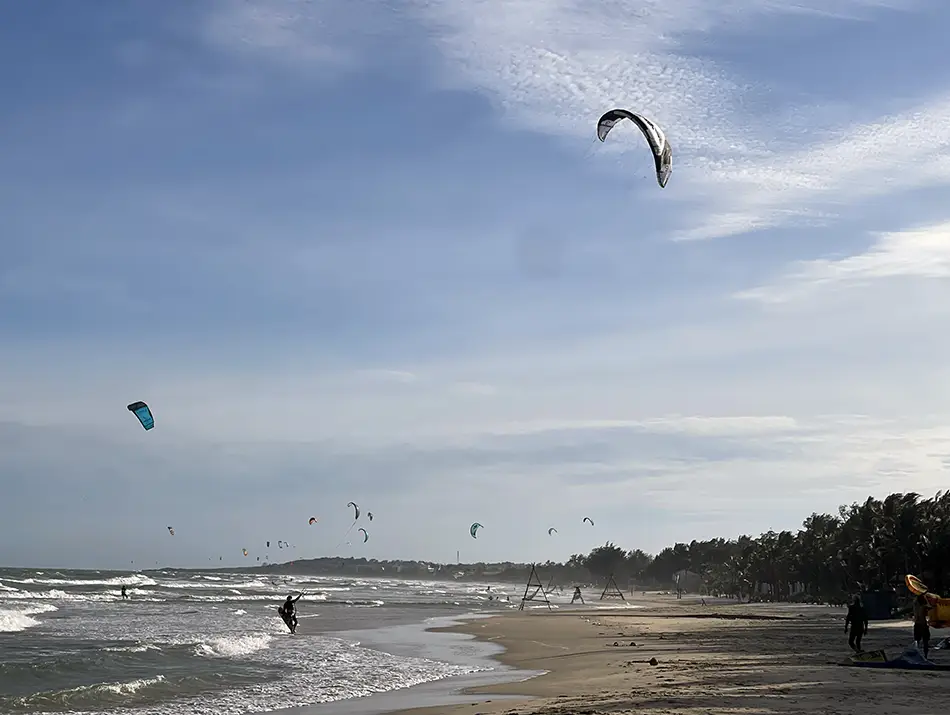
Mui Ne has two distinct beaches, and they offer very different experiences.
Central Beach
This is the main tourist strip where most hotels are located. It’s decent for learning, but the waves form very close to the shore.
- The Challenge: Getting past the shorebreak and your first “water starts” can be tricky.
- The Payoff: Once your instructor teaches you how to get past the lineup, you practice on “chop”—large water mounds that don’t break. It’s bumpy, but you won’t get “washed” by a wave.
Malibu (Wave Spot)
Located about 30 minutes from the center on the other side of the cape, Malibu is more technical but has its perks.
- The Pros: The waves are higher but break further out. Between the waves, the water is actually flatter than at the Central Beach.
- The Bonus: There are fewer schools and fewer beginners. You’re less likely to tangle lines with someone else, and the experienced riders there know how to steer clear of students.
What is the best time for kitesurfing lessons in Mui Ne
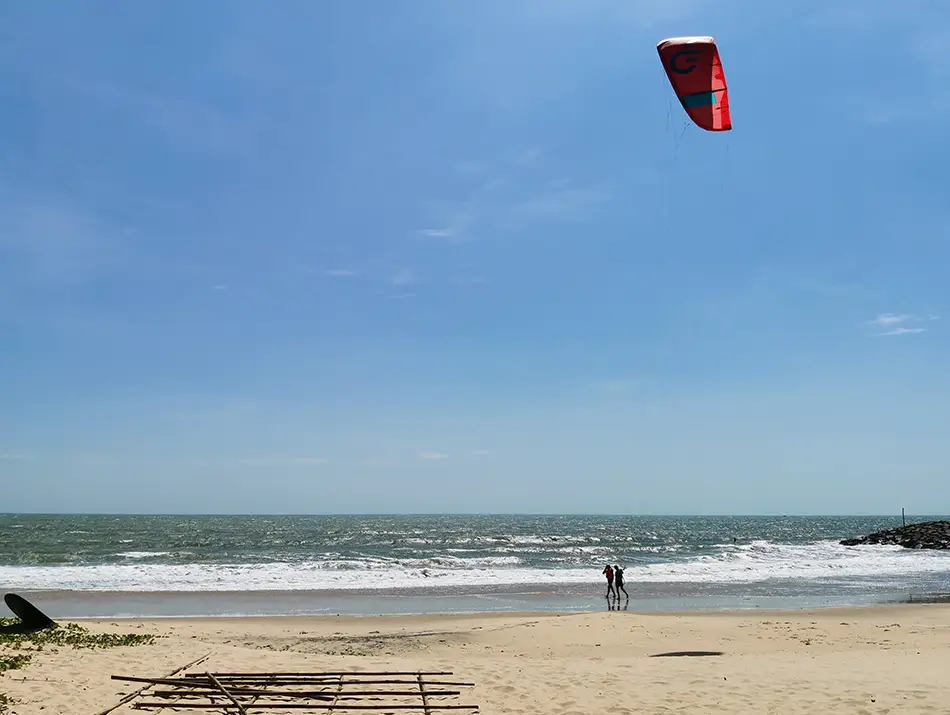
If you want to ensure your trip isn’t spent just staring at a flat sea, you need to time your arrival correctly. The best time for kitesurfing lessons in Mui Ne is roughly from the end of November until the end of March. This is the prime window when the winds are at their best and most consistent, showing up almost every single day.
Typically, the breeze starts in the morning and steadily strengthens until late noon. For a beginner, this is crucial because it allows you to catch the consecutive windy days needed to move through your progression quickly without losing momentum.
Outside of this main windy season, kite lessons are also possible using larger kite sizes to catch lighter breezes, but consistency is never a guarantee. If you are serious about learning and want to make the most of your budget, stick to the winter months.
Climate and conditions
During this peak period, you can expect some of the best weather in Southeast Asia:
- Air Temperature: Daytime highs average around 86°F (30°C), making it pleasantly warm but not sweltering, thanks to the constant breeze.
- Water Temperature: The sea is invitingly warm, averaging between 77°F (25°C). It is comfortable enough for board shorts, though most students prefer a rash guard for protection.
- Sunshine: This is the dry season, meaning you can count on roughly 5 to 6 hours of direct daily sunshine and almost zero chance of rain. Statistically, Mui Ne is one of the driest region in Vietnam, ensuring your training days are bright and clear.
How to choose your Kitesurfing School in Mui Ne
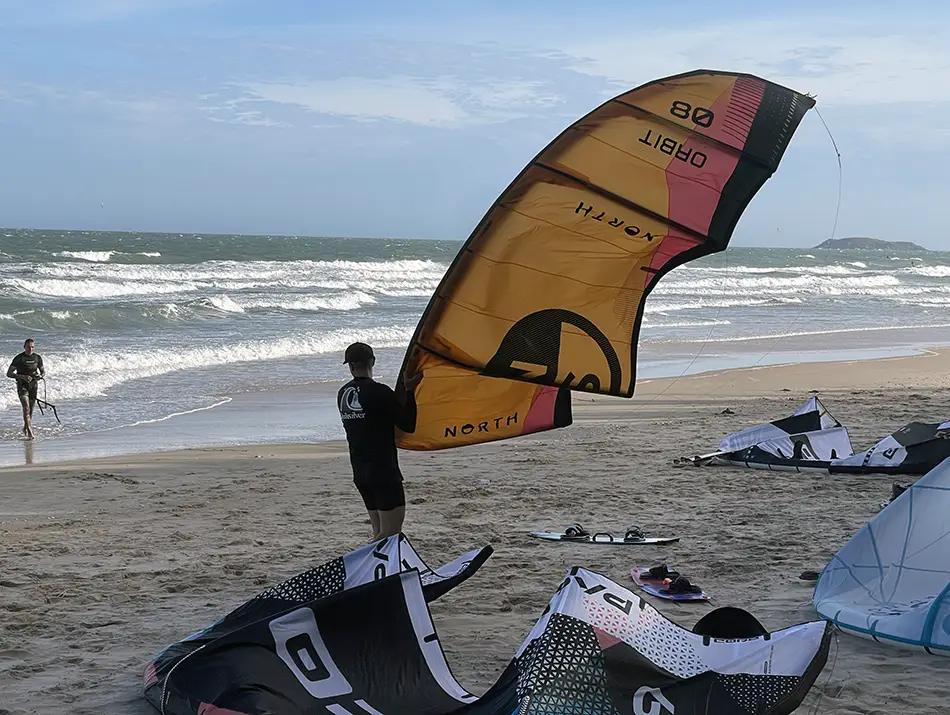
As a station owner, I’ll tell you: most kitesurfing schools in Mui Ne teach at a high level and keep their gear in good shape. Instead, focus on these factors:
Communication.
This is the #1 factor. You need 100% clarity with your instructor. While most kitesurfing schools in Mui Ne offer lessons in English, if that’s not your first language, find someone who speaks your native tongue. For example, at K1 Surf we focus on English and Russian, while Source Kitesurfing School is excellent for French speakers, and MKS is great for German. Don’t buy a pig in a poke—talk to your instructor over the phone or in person before booking a full course.
Insurance and Responsibility.
Before you hook into a harness, be sure to clarify exactly who is responsible for gear damage if something goes wrong during your classes. Kites are expensive and fragile, and a simple beginner mistake can lead to a costly canopy blowout or a tear. Most reputable schools in Mui Ne include equipment insurance in their lesson price, but you should never assume this is the case.
Ask upfront if you are covered under their policy while under instruction or if you will be handed a repair bill for accidental damage. Having this coverage can save you from an unexpected expense ranging from a few hundred to over a thousand dollars.
Safety Equipment.
Ensure the school provides more than just the kite and board. A school should include a high-visibility impact vest, a helmet, and a radio for real-time coaching while you are out in the water.
How long does it take to learn to kitesurf in Mui Ne
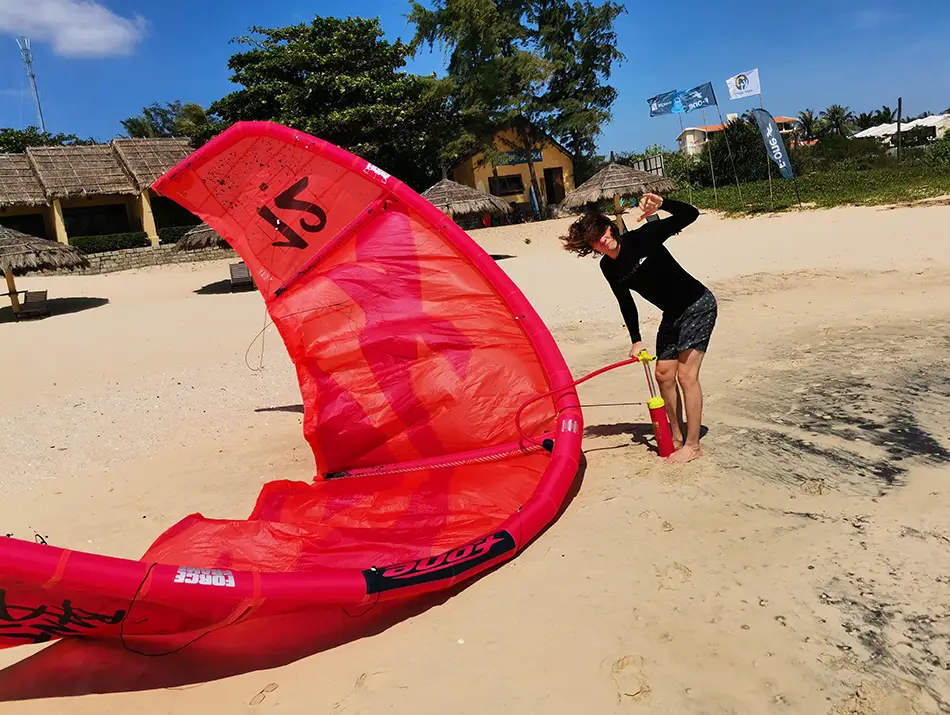
Kitesurfing isn’t like regular surfing in Vietnam. You can’t just “try it” for an hour and catch a wave. In surfing, an instructor can push you onto a “white water” wave in 20 minutes. In kitesurfing, no sane instructor will let you in the water with a board until you understand how the “kite” works and develop basic muscle memory. It’s a safety issue for you and everyone on the beach.
- The Commitment: Be ready for at least 10–15 hours (4–7 days) of active training.
- The Timeline: Don’t plan on 5 days straight. You’ll get exhausted, or the wind might drop for a day. I usually recommend a 10-day window to comfortably finish a course.
Cost of kitesurfing lessons in Mui Ne in 2026
Kitesurfing can look like a big budget item, but let’s compare it to skiing. In skiing, you always pay for lift tickets, no matter how good you are. In kitesurfing, the wind is free. Once you have the skill and your own gear, your sessions cost zero dollars.
- Hourly Rates: In 2026, a fair price for 1-on-1 instruction in Mui Ne is around $50–65 (€45–55 ) per hour.
- Pro Tip: Don’t book just 1 hour, it’s a waste of time. Most serious intro programs start at 6 hours minimum.
Muine kitesurfing lessons package price table
*Collected early 2026 from official websites of Mui Ne Kiteschools.
| 6 hours | 7 hours | 9 hours | 10 hours | 15 hours | |
| Jibes Kitesurfing School | $280 (€240) | $410 (€350) | |||
| K1 Kitesurfing School | $320 (€270) | $460 (€390) | $750 (€635) | ||
| Kitenam Kitesurfing School | $330 (€280) | $500 (€425) | |||
| S2SKY Kitesurfing School | $455 (€385) | $585 (€495) | $975 (€825) | ||
| Source Kitesurfing School | $330 (€280) | ||||
| Surf Point Kitesurfing School | $425 (€360) | $825 (€700) | |||
| VKS | 350$ (€300) | $450 (€380) | $675 (€570) |
Private vs group kitesurfing lessons
Some schools offer group lessons, which are slightly cheaper if you come as a pair. In my personal opinion, this can work well for the first two hours when you are covering theory and basic kite control on the sand.
However, once you transition to the water, I strongly recommend switching to one-on-one instruction. You really need the instructor’s undivided attention for safety and to ensure you aren’t spending half your expensive lesson time just watching someone else struggle.
Conclusion
So, back to the big question: Is it worth it to learn kitesurfing in Mui Ne?
Our answer from Guides & Stories is a resounding YES!
This coastal village is a fantastic location to dedicate five to ten days for training. It has everything you need and more, which is why we’ve put together all the details for you in our guides.
- Affordable Recovery: You’ll find some of the best and most affordable massages in all of Southeast Asia here, perfect for recovering after a tough session on the water.
- Adventure and Sightseeing: From sunrise jeep tours across the vast White Sand Dunes to exploring the “mini-canyon” of the Fairy Stream barefoot, there are plenty of incredible things to do in Mui Ne during your off-hours. You can also catch the sunset at the Red Sand Dunes or visit the historic Po Shanu Cham Towers for a bit of local culture.
- Great Food: There are excellent cafes and restaurants featuring both authentic Vietnamese flavors and high-quality European cuisine.
- Sports Community & Nightlife: Mui Ne has a great athletic community and even a bit of nightlife, so there is plenty to do when you aren’t training—all while keeping things very budget-friendly.
It’s not like heading to Bali for a surf camp. Here, everything remains authentic and accessible for those who really want it. So go for it, pick your school, and we’ll see you on the water!