


Why Visit Hue: Its Unique Charm and Vibe
Hue, the former imperial capital of Vietnam, rests quietly on the banks of the Perfume River (Song Huong). Unlike the frenetic energy of Hanoi or Ho Chi Minh City, this city offers a more contemplative pace. The best things to do in Hue are centered around its profound history, from the sprawling Citadel to the serene royal tombs scattered across the countryside. This destination is ideal for travelers interested in history, architecture, and exceptional regional food.
However, those seeking vibrant nightlife or beach resorts will find Hue lacking. Still, for visitors who appreciate a slower, more culturally immersive experience, Hue provides a unique window into the country’s feudal past.
One Minute History Lesson
Hue’s identity was forged as the capital of the Nguyen Dynasty, Vietnam’s last imperial family, from 1802 to 1945. The emperors constructed the magnificent Imperial City which contains the Forbidden Purple City, a palace complex modeled on Beijing’s Forbidden City. This era of imperial grandeur came to a violent end during the mid-20th century conflicts.
During the Vietnam War, became the site of the intense Battle of Hue in 1968 which lasted over one month. The fighting devastated the city, destroying many of the historical structures within the Citadel.
Today, ongoing restoration work slowly pieces back this fractured history, and the city stands as a powerful symbol of both imperial glory and modern resilience.
Table of Contents

Hue at a Glance
- Known For: The Imperial City (Citadel), royal tombs of the Nguyen emperors, and a distinct and refined regional food scene.
- Best Time to Visit: The spring months of March and April are often the most pleasant for sightseeing before the intense summer heat begins.
- Getting There: Phu Bai International Airport (HUI) serves a growing number of both domestic and international flights. Trains and sleeper buses connect Hue with Hanoi to the north and Da Nang/Hoi An to the south.
- How Long to Stay: A two-night stay allows enough time to see the main sights. Add a third night to explore the countryside and tombs at a relaxed pace.
- Average Daily Spending:
- Budget: 900,000–1,250,000 VND ($36–$50 / €33 –€45)
- Mid-Range: 1,500,000–2,500,000 VND ($60–$100 / €55–€91)
- Luxury: 4,000,000+ VND ($160+ / €145+)
Planning Your Trip to Hue
Best Time to Visit Hue
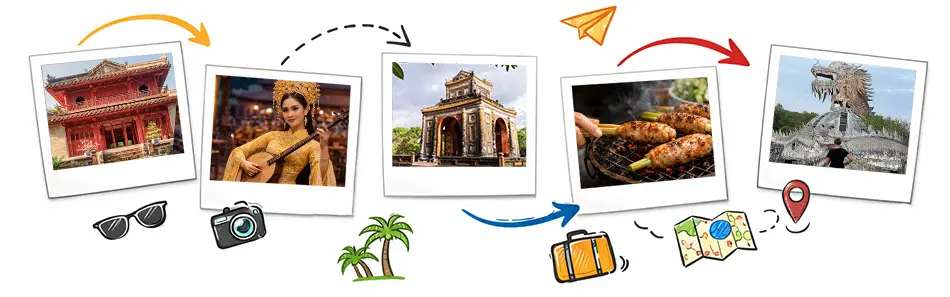
Choosing the right time to visit Hue is crucial due to its distinct rainy and dry seasons. The dry season runs from February to August and is the most popular period for sightseeing. Within this time the window from February to April offers the most pleasant conditions with mild temperatures between 68°F and 80°F (20°C to 27°C). From May to August the weather becomes intensely hot and temperatures often exceed 95°F (35°C) which makes early morning visits to the tombs and Citadel essential.
The rainy season begins in September and lasts through January bringing high humidity and frequent downpours. October to December marks the peak of the monsoon with a high risk of flooding that can disrupt travel plans. By January the heavy rains transition into a cool and atmospheric mist that remains damp and chilly but provides a unique and poetic perspective of the imperial city.
How Long to Stay in Hue
Two to three full days is the ideal amount of time for a first-time visitor. This allows you to dedicate one day to the vast Imperial City and major sights on the north bank of the Perfume River. A second day can be used to explore two or three of the most impressive royal tombs, which are located in the countryside south of the city.
While Hue is a highlight, some travelers combine it with other best places to visit in Vietnam like Da Nang or Hoi An. A day trip from these cities is technically possible, but it makes for a very long and rushed day. You would only have time for the Citadel and perhaps one nearby tomb.
A longer stay of four or more days is justified for history enthusiasts who want to see all the major tombs, explore the DMZ (Demilitarized Zone) on a day trip, or bike through the surrounding villages and garden houses at a leisurely pace.
How to Get to Hue: Transportation Options

Hue is a major transportation hub in central Vietnam, making it relatively easy to reach. Options for how to get to Hue vary by starting point.
From Hanoi, the most popular options are the overnight train or a sleeper bus. The train journey takes about 13–14 hours, offering a classic Vietnamese travel experience. Buses are cheaper but less comfortable. A direct flight from Hanoi (HAN) to Hue (HUI) takes just over an hour.
From Da Nang or Hoi An, the journey is much shorter. A train from Da Nang to Hue takes around 2.5–3 hours and is regarded as a scenic coastal ride with views of the mountains and sea near the Hai Van area. Buses and limousine vans are a frequent and affordable option that typically takes about 1.5–2 hours. Many travelers hire a private car or motorbike to travel between these cities, allowing for scenic stops along the Hai Van Pass.
From Ho Chi Minh City, flying is the most practical option. A direct flight from Ho Chi Minh City (SGN) to Hue (HUI) takes about 1.5 hours. The train and bus journeys from the south are very long (20+ hours) and only recommended for the most intrepid travelers.
Getting Around
The central areas of Hue are quite walkable especially the tourist-heavy south bank of the Perfume River. To cross the river and reach the Citadel walking is possible but once inside the massive fortress you may prefer using the onsite electric shuttles to save time and energy. Getting around Hue for longer distances is straightforward.
Ride-hailing apps like Grab and Xanh SM are widely available for cars and motorbikes and you can even use Grab to book a traditional cyclo with fixed pricing.
Traditional taxis are also present and while you should ensure the meter is used for short trips many companies now offer competitive fixed-rate packages for full-day sightseeing.
For visiting the royal tombs which are spread out in the countryside hiring a private car and driver for a half or full day is a popular and efficient choice.
Renting a bicycle or scooter is another great way to explore at your own pace especially along the pleasant riverfront roads.
Where to Stay in Hue
Accommodation in Hue is plentiful and caters to all budgets. The city is primarily divided by the river into two main areas for tourists. The area south of the river, centered around Le Loi and Chu Van An streets, is the modern city center. This is where you’ll find the highest concentration of hotels, guesthouses, restaurants, and bars. It’s convenient and lively, though it can be noisy at night.
For a quieter experience, consider staying on the north side of the river closer to the Imperial City. This area has a more local feel with fewer tourist-focused businesses and some charming smaller guesthouses. Another option is to stay in a resort or guesthouse along the river a bit outside the city center which offers more tranquility and scenic views.
For a unique stay, Azerai La Residence, Hue is a landmark property with significant historical pedigree located in a former colonial governor’s residence on the south bank.
Is it Expensive to Visit Hue in 2026?
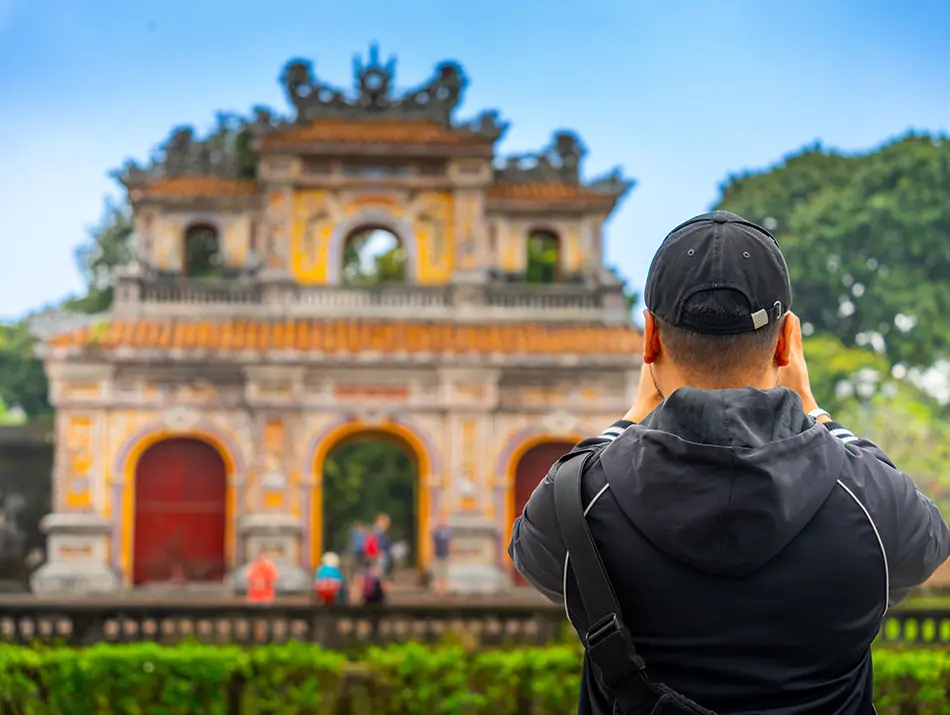
Compared to other major destinations in Vietnam, Hue offers a mix of affordability and premium sightseeing costs. Street food and local restaurants offer excellent value and accommodation is generally cheaper than in Hanoi or Hoi An. However, while daily living costs are low, Hue can be surprisingly expensive for sightseers due to some of the highest entrance fees in the country.
- Hue Imperial City (The Citadel) Entry: VND 200,000 ($7.5 / €6.5)
- Royal Tombs (Minh Mang / Khai Dinh / Tu Duc): VND 150,000 ($5.5 / €5) each. A 3-site combo (Citadel + 2 Tombs) is available for VND 420,000, and a 4-site combo is VND 530,000 ($20 / €17.5).
- Standard Private 3-Star Hotel: VND 450,000–850,000 ($17–32.5 / €14.5–28) per night
- Budget Hostel Dorm Bed: VND 80,000–160,000 ($3–6 / €2.5–5) per night
- Meal at an Inexpensive Local Restaurant: VND 50,000 ($2 / €1.5)
- Motorbike Rental (Economy Scooter): VND 120,000–150,000 ($4.5–5.5 / €4–5) per day
- Intercity Transport (Hue to Da Nang): VND 130,000–250,000 ($5–9.5 / €4.5–8)
Best Things to See in Hue: Sights & Attractions
Hue served as Vietnam’s imperial capital for over a century. The city’s identity is defined by the legacy of the Nguyen Dynasty. Most of the top attractions in Hue are concentrated within the former citadel or along the Perfume River, where emperors built their grand tombs.
These historical sites provide a direct look into the country’s feudal past. Exploring them involves significant walking, often in exposed, sunny conditions.
Hue Imperial City (The Citadel)
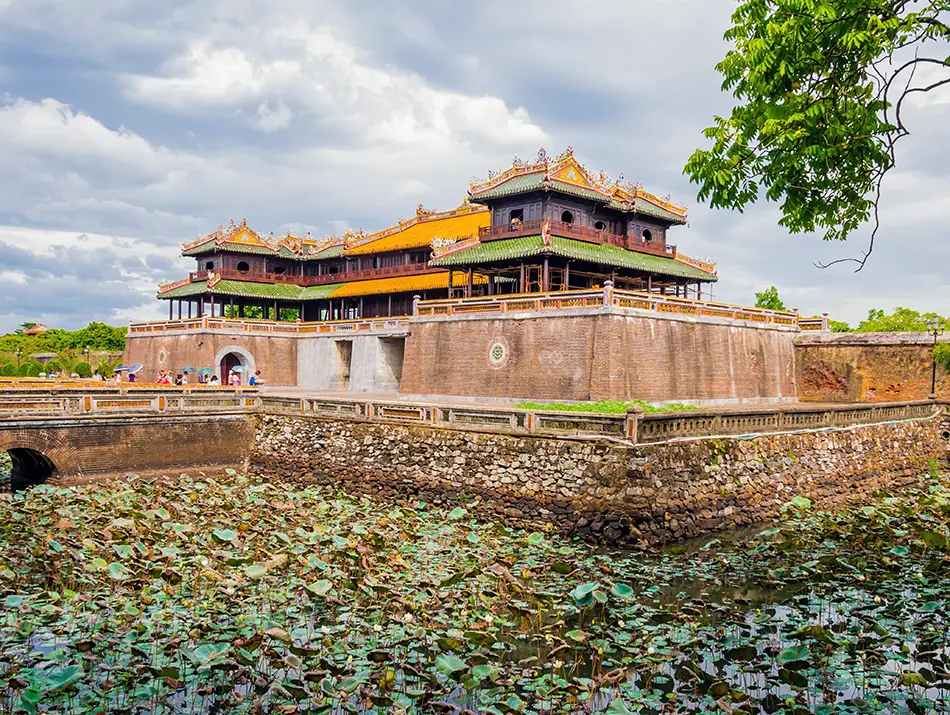
The Hue Imperial City is a vast, walled complex that was the political and cultural center of Vietnam from 1802 to 1945. It contains the Imperial City, several temples, and the Forbidden Purple City, which was the emperor’s private residence. Large portions of the complex were destroyed during the Vietnam War, but extensive restoration projects have brought many areas back to life.
Visitors enter through the massive Ngo Mon Gate to explore the grounds. You will walk through courtyards and see the restored Thai Hoa Palace, where major ceremonies took place. Other notable structures include the The Mieu temple complex and the Halls of the Mandarins. Many areas remain as empty fields or ruins, which shows the scale of the past destruction.
- Hours and tickets: 7:00 AM – 5:30 PM daily. A single ticket costs 200,000 VND (around $8 USD/€7.50).
- Time needed: 2–3 hours. The grounds are extensive.
- Travel Tip: Visit early in the morning or late in the afternoon to avoid the midday sun and the largest tour groups.
- 📍Hue Imperial City on Google Maps
Thien Mu Pagoda

Located on a hill overlooking the Perfume River, Thien Mu Pagoda is an iconic symbol of Hue. The seven-story Phuoc Duyen Tower, built in 1844, is the most recognizable feature. The pagoda has a long history tied to both royal and political events. It remains an active Buddhist monastery.
The main experience involves climbing the steps from the riverbank to the pagoda complex. You can see the main tower, explore the temples behind it, and view the river from the grounds. The site also houses the Austin motor car that transported monk Thich Quang Duc to his self-immolation in Saigon in 1963, a pivotal moment in Vietnamese history.
- Hours and tickets: 7:00 AM – 6:00 PM daily. Admission is free.
- Travel Tip: Arriving by boat provides a unique perspective of the pagoda from the water.
- 📍 Thien Mu Pagoda on Google Maps
Tomb of Tu Duc
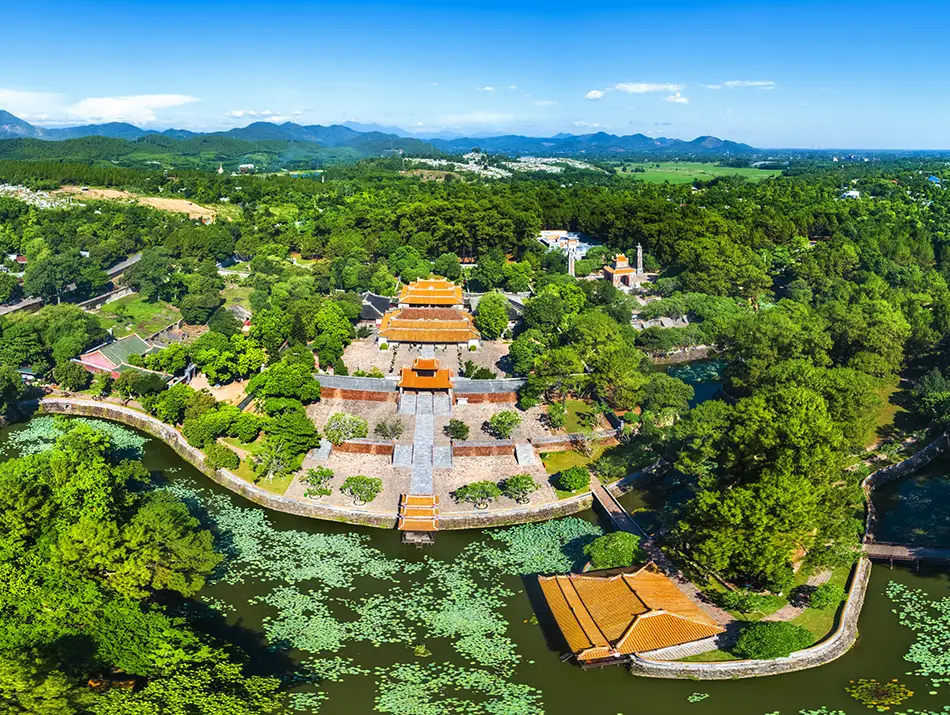
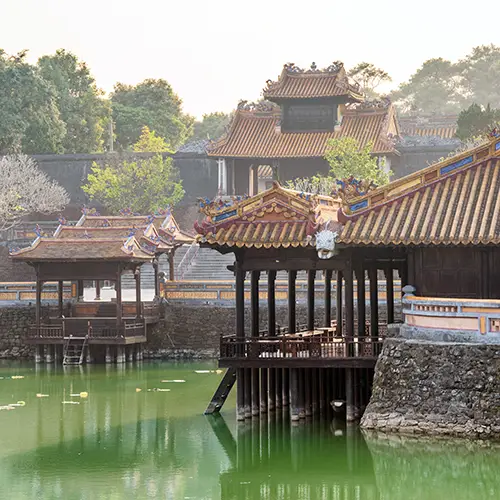
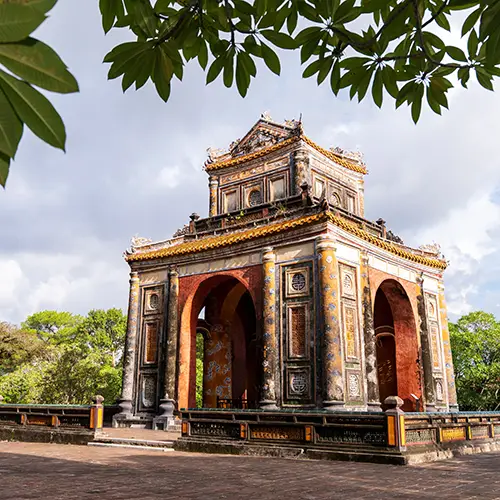
The Tomb of Tu Duc is a sprawling complex of palaces, temples, and pavilions set around a serene lake. Emperor Tu Duc designed the tomb himself for use during his lifetime as a royal retreat. The atmosphere is more subdued and integrated with nature compared to other tombs.
You can walk along the paths that wind around Luu Khiem Lake and explore the various structures. The tomb area feels more like a park than a gravesite. Key buildings include Hoa Khiem Palace, where the emperor worked, and the Xung Khiem Pavilion. The emperor’s actual burial site is sealed and remains a secret.
- Hours and tickets: 7:00 AM – 5:30 PM daily. Tickets cost 150,000 VND (around $6 USD/€5.50).
- How to get there: Located about 4 miles (6 km) southwest of Hue. A taxi or scooter is the most direct way to get there.
- Combines with: The Tomb of Khai Dinh and Thuy Xuan Incense Village are nearby.
- 📍 Tomb of Tu Duc on Google Maps
Tomb of Khai Dinh
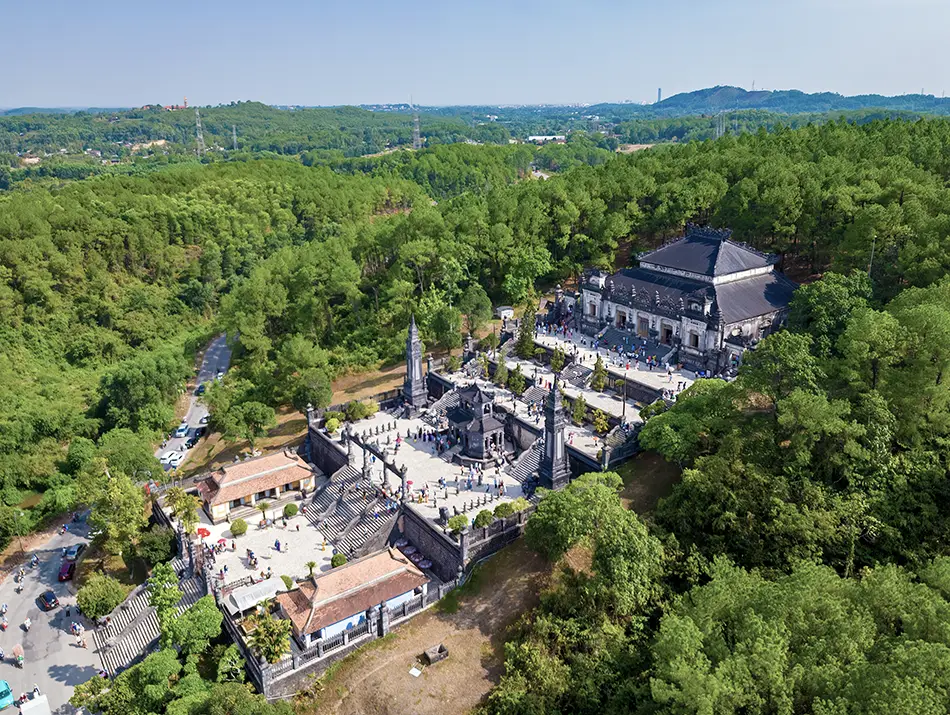
The tomb is famous for its unique fusion of Vietnamese, European, Hindu, and Buddhist architectural styles. Built from 1920 to 1931, it is the last grand Nguyen Dynasty tomb. The structure is made largely of concrete and sits on a steep hillside, creating a commanding presence.
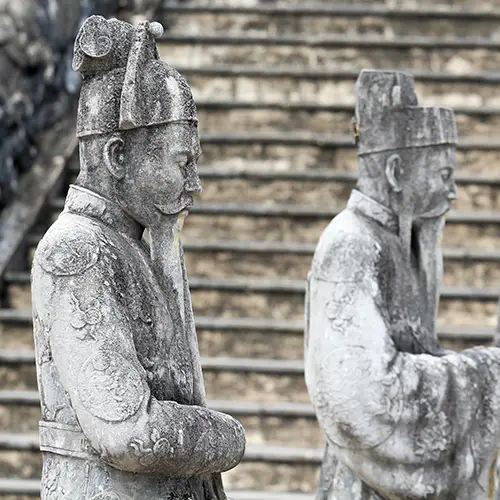
A visit requires climbing 127 steps to reach the main courtyard and Thien Dinh Palace. The courtyard features an honor guard of stone soldiers and mandarins. The palace interior is decorated with intricate glass and ceramic mosaics.
Unlike other royal tombs where the actual burial sites are secret, Emperor Khai Dinh is known to be buried here, specifically 59 feet (18 meters) directly below his seated bronze statue.

- Hours and tickets: 7:00 AM – 5:30 PM daily. Tickets cost 150,000 VND (around $6 USD/€5.50). It is also part of the combo ticket.
- Combines with: Tomb of Tu Duc.
- 📍 Tomb of Khai Dinh on Google Maps
Tomb of Minh Mang

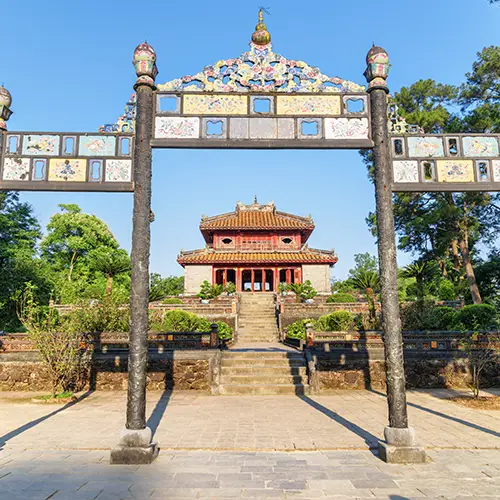
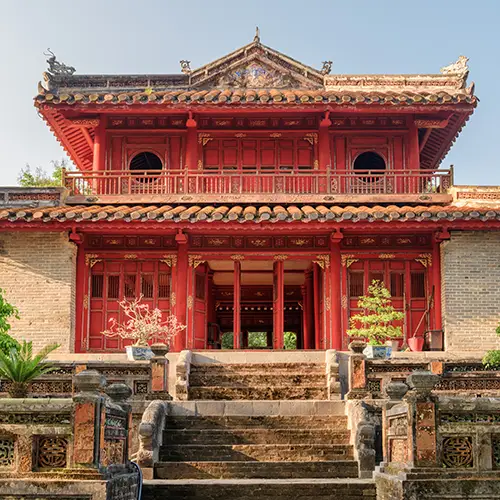
The Tomb of Minh Mang is considered a model of traditional Vietnamese design. The complex is known for its formal symmetry and its harmonious integration into the surrounding landscape. Forty structures are arranged on a single axis that runs through the site.
The experience involves walking a straight path across lakes and through courtyards to reach the main temples and the emperor’s burial mound. You will cross several bridges and pass through ceremonial gates. The tomb feels formal and peaceful due to its rigid layout and natural setting.
- Hours and tickets: 7:30 AM – 5:30 PM daily. Tickets cost 150,000 VND (around $6 USD/€5.50). It is included in the combo ticket.
- Travel Tip: Due to its distance, this tomb is often less crowded than the tombs of Tu Duc and Khai Dinh.
- 📍 Tomb of Minh Mang on Google Maps
An Dinh Palace
An Dinh Palace was the official private residence of Khai Dinh before he became emperor and later home to Emperor Bao Dai’s family. The palace is a famous example of “Indochinese” fusion and has recently gained fame as a filming location for popular Vietnamese historical films and music videos.
The main attraction is Khai Tuong Hall, a three-story building with elaborate murals on the interior walls. Visitors can explore the furnished rooms and see photographs of the last royal family. The palace offers a glimpse into the modernizing monarchy of the period.
- Hours and tickets: 7:00 AM – 5:30 PM daily. Tickets cost 50,000 VND (around $2 USD/€1.80).
- How to get there: The palace is on the south bank of the river, within easy walking or cycling distance of the main tourist area.
- Time needed: 45 minutes.
- Travel Tip: It is a smaller, quicker visit than the main Imperial City, making it a good option if you are short on time.
- 📍 An Dinh Palace on Google Maps
Thanh Toan Covered Bridge

This wooden, tile-roofed bridge crosses a small canal in a rural village outside Hue. Built in the 18th century, it features a small altar inside dedicated to its founder. The bridge serves as a social hub for local residents.
Visiting the bridge provides an opportunity to see a slice of village life. You can walk across the bridge, visit the small local market nearby, and explore the Exhibition House of Agricultural Tools to see traditional rice-farming equipment and local fishing traps. The surrounding area is flat and filled with rice paddies, offering a contrast to the city center.
- Hours and tickets: The bridge is open 24/7 and free to visit
- 📍 Thanh Toan Bridge on Google Maps
Famous Museums in Hue
- 📍 Hue Museum of Royal Antiquities: Housed in the Long An Palace, this museum displays a premier collection of Nguyen Dynasty furniture, ceramics, and royal clothing.
- 📍 Lebadang Memory Space: A private art park dedicated to the modernist artist Le Ba Dang. It is one of Hue’s most striking contemporary sites, blending underground galleries with minimalist architecture and lush gardens.
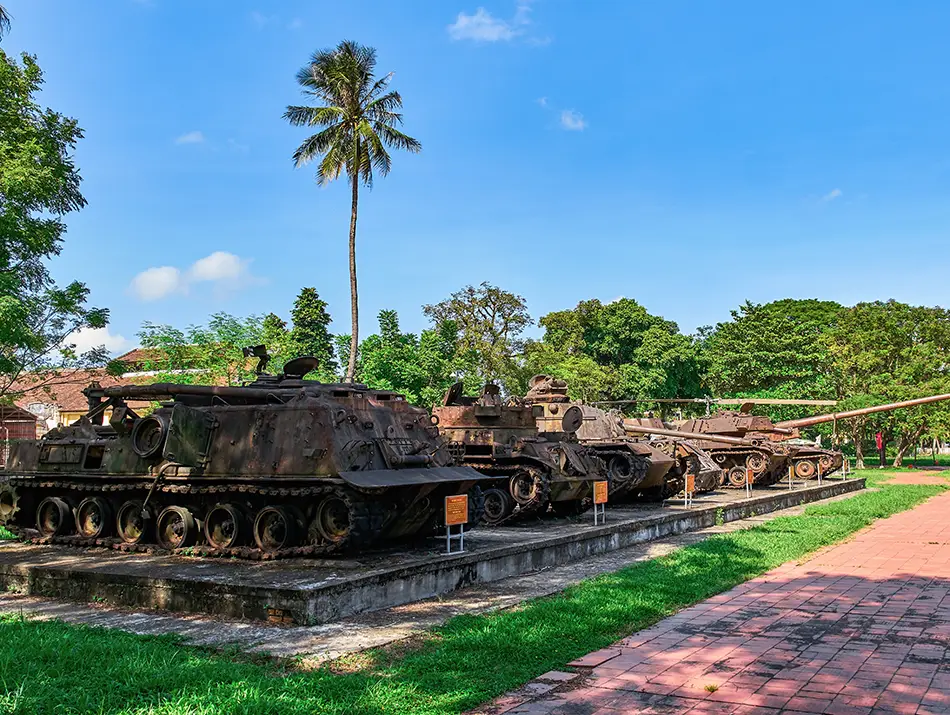
- 📍 Historical and Revolutionary Museum: This museum chronicles regional history from prehistoric times to the modern era. It is particularly popular for its collection of military aircraft and tanks from the Vietnam War.
- 📍 Ho Chi Minh Museum (Hue): This museum documents the childhood and formative years that Ho Chi Minh spent living and studying in the central Vietnam region between 1895 and 1909.
Best Things to Do in Hue: Activities & Experiences
Beyond the historical monuments, Hue offers a variety of experiences that connect you with its culture, cuisine, and landscape. These Hue activities often move at a slower pace, centered on the river, local villages, and the city’s renowned food scene. They provide a practical way to understand daily life in the former imperial capital.
Take a Dragon Boat Cruise on the Perfume River
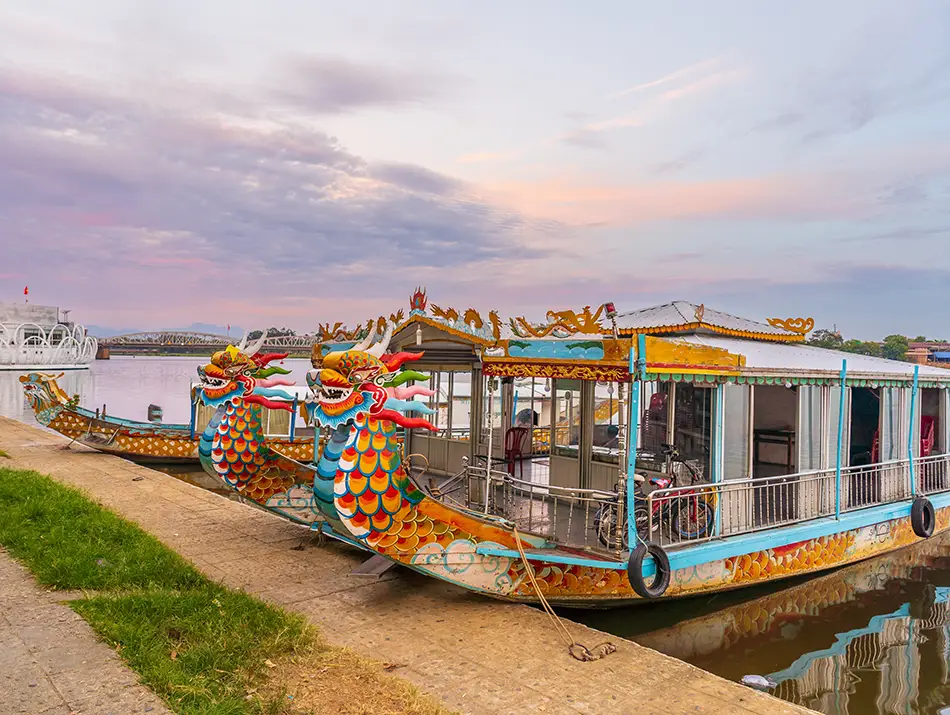
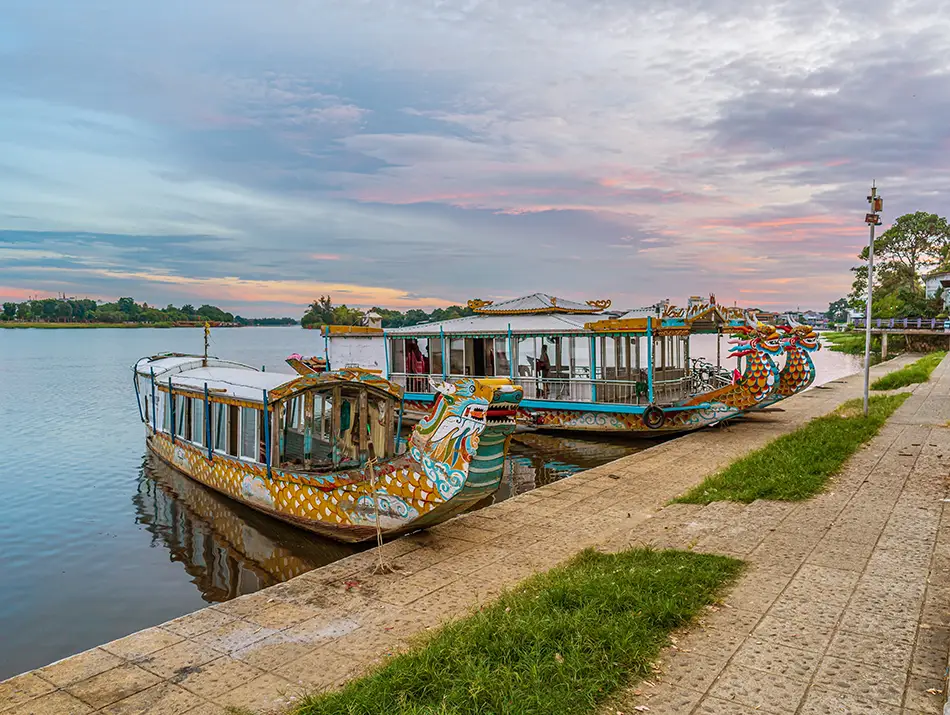
To experience one of the best things to do in Hue, board a traditional dragon boat—easily recognized by its vibrantly carved prow—for a slow-paced journey along the water. These cruises range from brief sightseeing trips to extensive excursions that dock at the legendary royal tombs.
As you glide along, the boat reveals a unique perspective of both the urban landscape and the lush countryside. You will witness local life unfolding along the riverbanks and pass beneath historic bridges that span the water.
Once the sun sets, these vessels transform into floating stages for Ca Hue (Royal Chamber Music). During these evening performances, musicians in elegant traditional dress play classic stringed instruments and sing folk songs, keeping Hue’s imperial heritage alive.
- Hours and tickets: Boats are available throughout the day. A standard 1-hour cruise starts at approximately 200,000 VND ($7.85 / €7.30), while multi-stop private tours can reach 600,000 VND ($23.50 / €21.80) or more.
- How to get there: Boats primarily depart from the !📍Toa Kham Boat Station and the main Tourist Boat Pier near the 📍Trang Tien Bridge.
- Travel Tip: Agree on the price, duration, and all stops with the boat operator before departing to avoid confusion.
Attend a Hue Royal Court Music Performance (Nha Nhac)

Nha Nhac, recognized by UNESCO as an Intangible Cultural Heritage, was the official court music of the Nguyen Dynasty. Performances feature musicians in elaborate costumes playing a range of unique instruments. It is a formal, highly structured musical tradition.
To hear these sounds for yourself, head to the Duyet Thi Duong Royal Theater—the oldest venue of its kind in Vietnam. The music can sound unusual to an unaccustomed ear, with a slow, deliberate pace. It is an authentic cultural experience that offers insight into the rituals of the former royal court.
- Hours: Performances are held twice daily: the morning show is from 10:00 AM – 10:35 AM, and the afternoon show is from 3:00 PM – 3:35 PM.
- Tickets: While entry to the theater building is included with your Citadel ticket, attending a live performance requires a separate ticket costing 300,000 VND ($11.75 / €10.95).
- Travel Tip: Performances generally require a minimum of 10 attendees to proceed; it is wise to check at the theater entrance earlier in your Citadel tour to confirm the show is going ahead.
- 📍 Royal Theater on Google Maps
Join a Cooking Class in Thuy Bieu Village
The village is famous for its Thanh Tra pomelo orchards. If you visit in March or April, citrus blossoms fill the entire area with a sweet, fresh fragrance. Several local families host cooking classes that focus on Hue’s distinctive royal cuisine, often starting with a visit to the local market and a guided walk through the village.
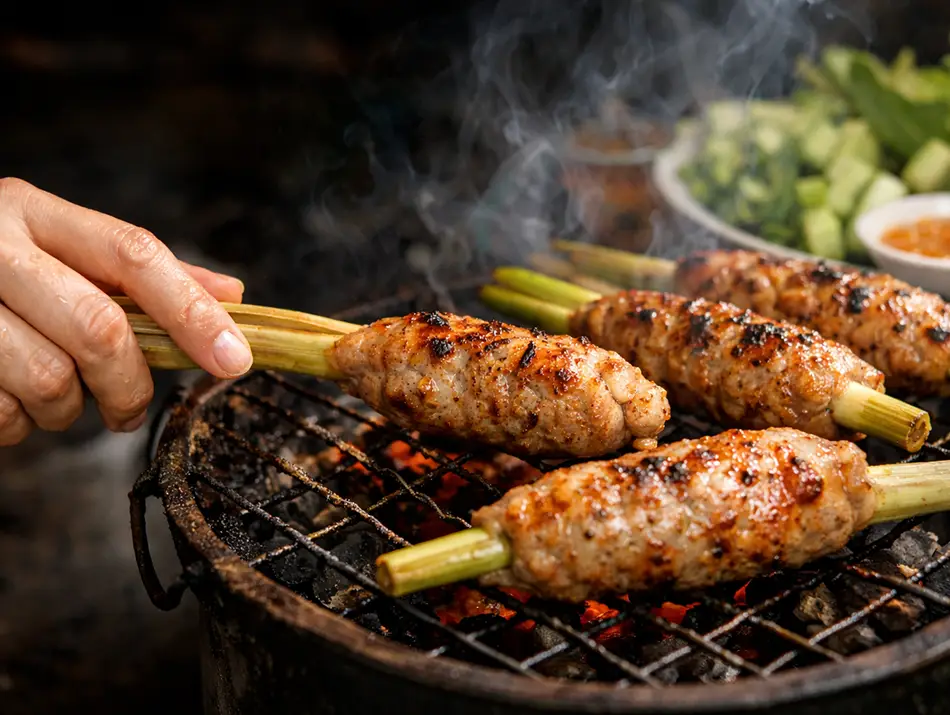
During the class, you learn to prepare classic Hue dishes such as Nem Lui (grilled pork), but many people consider Goi Buoi the highlight. This refreshing salad uses the village’s signature pomelo and showcases local flavors.
Hosts hold the classes in traditional Nha Vuon (garden houses) and often begin with a relaxing herbal foot bath made from lime and pomelo leaves. After cooking, you sit down and eat the meal you prepared.
- Hours and tickets: Classes are typically half-day experiences. Prices range from 700,000–1,200,000 VND ($28–$47 USD / €26-€44) per person.
- How to get there: Most classes include hotel pickup or are part of a tour that provides transportation.
- Time needed: 4–5 hours.
Visit an Incense-Making Workshop in Thuy Xuan Village

Thuy Xuan is a traditional village where artisans make incense sticks by hand. Along the main streets, workers lay out bright bundles of incense to dry in the sun, creating the colorful scenes the village is now known for and making it a top attraction in Hue for photography.
Visitors can enter small workshops to watch artisans coat bamboo sticks with aromatic paste, and some places let you try making incense yourself. The area feels highly commercialized, and vendors actively encourage souvenir purchases, so expect a tourist-focused stop rather than a quiet craft village.
- Hours and tickets: There is no official entrance fee, but it is polite to purchase a small pack of incense ($1.50–$3.90 / €1.45–€3.70) or a souvenir if you spend time taking photos in a workshop’s display area.
- How to get there: The village is located near the Tomb of Tu Duc, about 4 miles (7 km) from the city.
- Travel Tip: While photogenic, the experience can feel staged.
- 📍 Thuy Xuan Village on Google Maps
Go on an Evening Street-Food Crawl
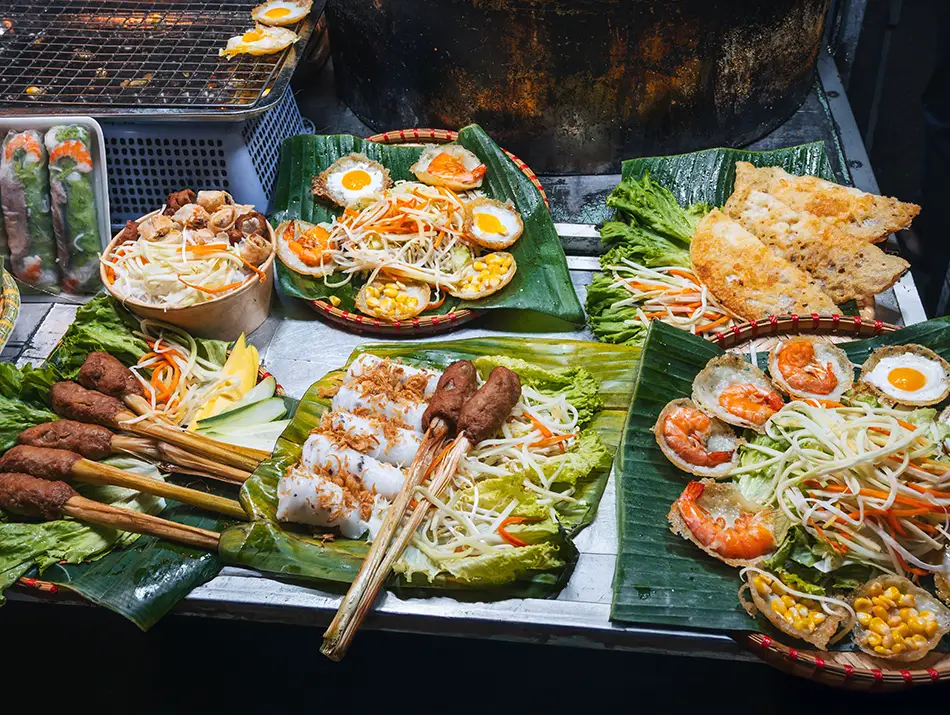
Hue is one of Vietnam’s top food destinations, with many dishes that are unique to the city. An evening street-food tour is an efficient way to sample the best local specialties. These tours are typically done on foot or by scooter.
Tours typically explore the narrow alleys of the Citadel for traditional “royal” cakes and the vibrant streets of the South Bank for modern night-market snacks. You will try a series of small dishes like Banh Beo (steamed rice cakes), Ram It (sticky rice dumplings), and the city’s famous Bun Bo Hue (spicy beef noodle soup). It is a good way to learn about the city’s food culture.
- Hours and tickets: Usually start in the late afternoon or evening. Prices are around 500,000–900,000 VND ($20–$35 USD/€18.50-€32.50) per person.
- How to get there: Tours typically include hotel pickup or a central meeting point.
- Time needed: 3–4 hours.
- Travel Tip: Most street-food tours can be easily customized for vegetarians. Just be sure to mention this when booking.
Explore Dong Ba Market

Dong Ba Market is the largest and oldest market in Hue. It is a busy, crowded place that serves the local community. The market offers everything from fresh produce and meat to clothing, housewares, and souvenirs.
Exploring the market is an intense sensory experience. You will navigate narrow aisles filled with sights, sounds, and smells.
The food section is particularly interesting, with a large, covered food court where you can try many local dishes for a low price. It is a great place to observe daily life.
- Hours: 7:00 AM – 7:00 PM daily.
- How to get there: The market is on the north bank of the river, just east of the Imperial City.
- Combines with: A visit to the Hue Imperial City.
- Travel Tip: The market is most active in the morning. Be prepared for crowds and a chaotic environment.
- 📍 Dong Ba Market on Google Maps
Walk Explorations in Hue
This section covers areas in Hue that are interesting to explore on foot but do not contain a single major attraction. Wandering through these neighborhoods allows you to absorb the local atmosphere away from the main tourist sites.
- Kim Long Garden-House Neighborhood: This quiet neighborhood is famous for its Nha Vuon (garden houses). While some remain private, you can now enter several restored estates to see the intricate woodwork and lush orchards. It is a perfect 30-minute walk from the Citadel’s west gate. The quiet, narrow lanes are ideal for a peaceful walk or bicycle ride. You can get a sense of old Hue’s aristocratic lifestyle here. The area can be located by heading west from the Citadel along the river.
- The “New City” South Bank: The South Bank is the city’s modern heartbeat. For the best experience, walk the riverside boardwalk near Le Loi Street at sunset, or head to the Phu Tay (Backpacker District) on Friday or Saturday nights when the streets become a pedestrian-only zone filled with live music and outdoor dining.
- Bao Vinh Ancient Town: Located 2.2 miles (3.5 km) north of the center, this former port town is Hue’s hidden “!mini Hoi An.” While less polished, the area is experiencing a revival with several 19th-century shophouses converted into charming riverside cafes. It offers a nostalgic, lived-in atmosphere that provides a sharp contrast to the grand architecture of the Citadel.
Best Day Trips From Hue
Hue’s location in central Vietnam makes it a convenient base for exploring a variety of nearby destinations. These day trips range from historical tours of war sites to scenic drives through mountains and visits to coastal lagoons.
Each requires a full day and arranged transportation, such as a private car, scooter, or organized tour.
Bach Ma National Park
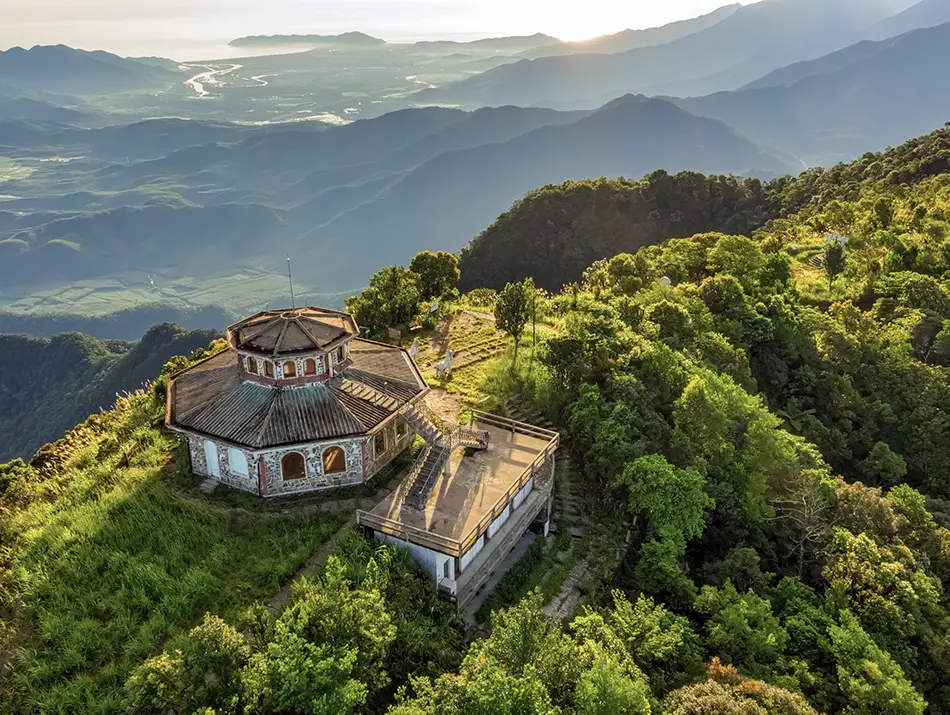
🛑 Temporarily closed due to damage caused by landslides.
Bach Ma National Park, a former French hill station, sits high within the mountain range separating Hue and Da Nang. Travelers prize the park for its refreshing climate and rich biodiversity, but the real draw remains the rugged hiking trails that lead to panoramic viewpoints and hidden waterfalls.
To start your adventure, you’ll typically drive to the summit before trekking along the Five Lakes Trail toward the towering Do Quyen Waterfall. While the park offers a serene natural escape from the city, you should prepare for sudden weather shifts and keep an eye out for leeches during the wet season.
- Logistics: The park is about 25 miles (40 km) from Hue. While you can reach the gate by private car or tour, all visitors must transfer to internal park transit vans to reach the 4,757-foot (1,450-meter) summit.
- 📍 Bach Ma National Park on Google Maps
DMZ and Vinh Moc Tunnels

The Vietnam DMZ (Demilitarized Zone) was the 3-mile (5 km) buffer zone on either side of the Ben Hai River that served as the border between North and South Vietnam from 1954 to 1975. Today, it is a site of historical reflection, with attractions split into two distinct areas.
The Coastal Route (Half-Day Option): Located 65 miles (105 km) north of Hue, this area includes the Hien Luong Bridge, which is painted half-yellow and half-blue to mark the former border line. Nearby are the Vinh Moc Tunnels, a three-level underground village where civilians lived 75 feet (23 meters) below ground to survive heavy shelling.
The Mountain Route (Full-Day Addition): Located 105 miles (170 km) northwest of Hue near the Laos border, this route features the Khe Sanh Combat Base, a former U.S. Marine stronghold, and The Rockpile observation post.
Logistics and Planning:
- Duration: 5–6 hours for the Coastal Route; 10–12 hours for the Full DMZ.
- Transport: Most book group tours, but adventure-seekers often plan 2-3 day self-drive motorbike trips to combine the DMZ with the scenic Ho Chi Minh Highway.
- Tickets: Entrance to each major site (Tunnels, Bridge, Combat Base) is 50,000 VND ($1.95 / €1.85).
Ride the Hai Van Pass and Coastal Stops

The Hai Van Pass is a scenic 13-mile (21 km) mountain road that connects the Hue and Da Nang regions. It offers panoramic views of the coastline. The pass became famous internationally after being featured on the television show Top Gear.
A day trip over the pass typically involves traveling from Hue to Da Nang or Hoi An (or the reverse). You can stop at several viewpoints, including the recently restored Hai Van Gate, a 19th-century royal fortress that stands alongside French and American bunkers at the summit.
At the northern base of the pass, stops typically include the turquoise waters of Lang Co Beach and the scenic Lap An Lagoon, famous for its oyster farms and white sandbars.
- Logistics: The pass is best experienced by scooter or in a private car or jeep, which allows for frequent stops. It is often done as a one-way transfer between cities rather than a round trip.
- 📍 Hai Van Pass on Google Maps
Off the Beaten Path
For travelers looking to move beyond the main tourist circuit, Hue offers several locations that provide a more unfiltered view of local life and recent history. These places are not primary attractions and often lack visitor infrastructure.
These experiences are best suited for independent travelers who are comfortable with ambiguity and navigating non-tourist environments.
An Bang Cemetery
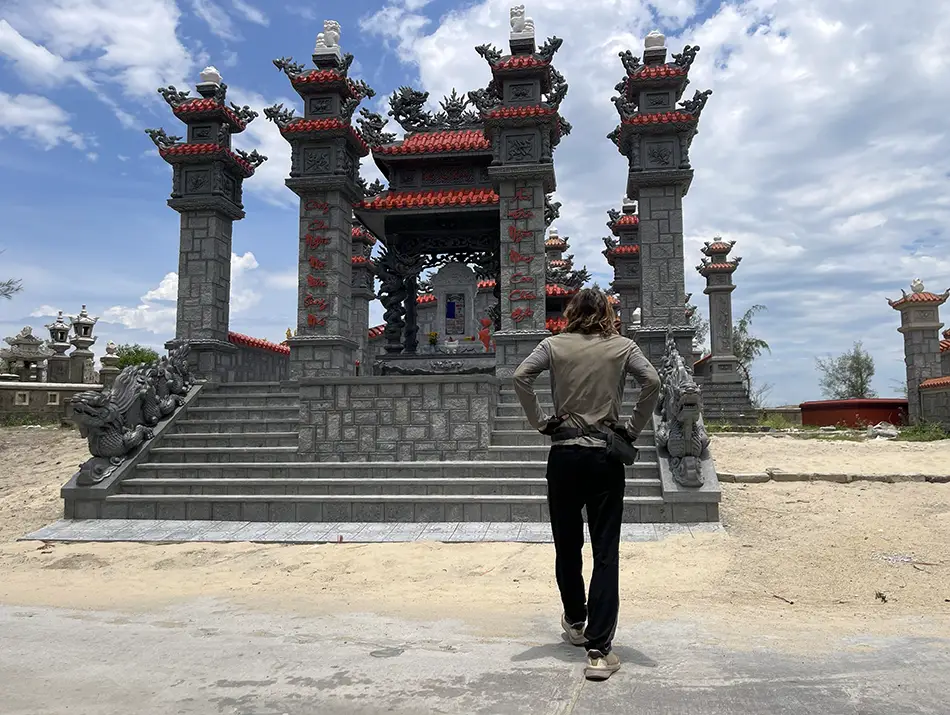
Known locally as the “City of Ghosts,” An Bang Cemetery is a startling and elaborate burial ground in a coastal fishing village. Funded by significant remittances from relatives living in the U.S. and Europe, these lavish “mansions for the dead” often cost between $25,000–$80,000 to construct. The tombs feature a surreal fusion of Buddhist, Christian, and Taoist motifs, utilizing the same intricate ceramic mosaic style found in Hue’s royal mausoleums.
A walk through the cemetery reveals a surreal landscape of colorful, palace-like structures complete with dragons, columns, and detailed mosaics. It is an active burial ground, not a tourist site, so visitors should behave with respect. The sheer scale and expense of the tombs are the main draw.
- Hours and tickets: Open access, no tickets required.
- Time needed: Half-day trip.
- Combines with: A visit to the Tam Giang Lagoon.
- Travel Tip: Dress modestly and be mindful that this is a place of remembrance for local families.
- 📍 An Bang Cemetery on Google Maps
Tam Giang Lagoon

Tam Giang Lagoon is part of the largest lagoon system in Southeast Asia. It is a vast, shallow body of brackish water known for its fishing communities and aquaculture farms. The area provides a look at a unique coastal way of life.
A trip to the lagoon is more about observing the landscape and local life than seeing specific sights. Activities include taking a boat trip through the fishing nets, visiting a floating village, and enjoying fresh seafood. Sunsets over the lagoon are particularly well-regarded.
- Logistics: The lagoon is about 9 miles (15 km) from Hue. A scooter or private car is the best way to explore the area. Some visitors opt to stay in a local homestay for a quiet, immersive experience focused on the local culture and environment.
- 📍 Tam Giang Lagoon on Google Maps
Ho Thuy Tien (Abandoned Water Park)
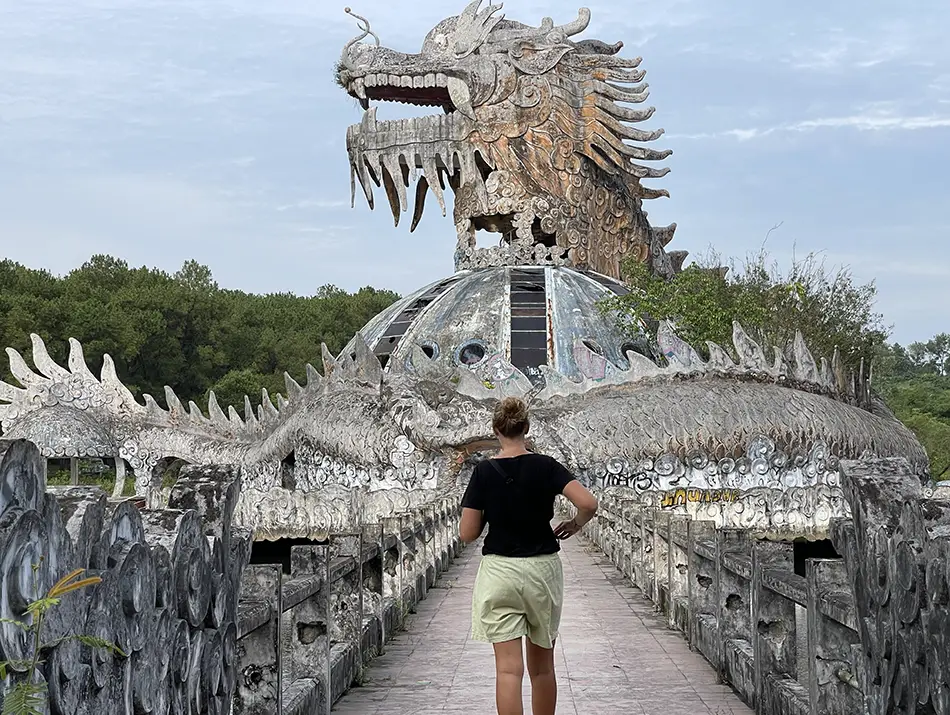
This abandoned water park has gained international fame through travel blogs and social media. The park was built in the early 2000s but never fully opened, leaving its structures to be reclaimed by nature. The centerpiece is a large, dragon-shaped aquarium on the lake.
The site is officially closed and slated for redevelopment. However, entry is often still possible by finding an unguarded entrance or paying a small, informal “fee” to a security guard. Visitors can explore the decaying slides, the empty aquarium, and the overgrown amphitheater.
The experience is eerie and popular for photography.
- Hours and tickets: Officially closed. Access is not guaranteed and may involve dealing with guards.
- How to get there: Located near the Tomb of Khai Dinh.
- Combines with: A tour of the royal tombs.
- 📍 Ho Thuy Tien on Google Maps
Best Sunset Spots in Hue

While Hue is not a coastal city, the high hills and broad river provide several serene locations to watch the day end. 📍 Vong Canh Hill, located about 4 miles (7 km) south of the city center, is the premier viewpoint. From its newly constructed observation tower, you can see the Perfume River’s “S-curve” and the distant, forest-shrouded royal tombs. The site is free to enter and is best reached by scooter or taxi.
Another classic experience is a late-afternoon dragon boat cruise. Floating upstream as the sun sets behind the Thien Mu Pagoda allows you to witness the river transform into a golden ribbon. Many 2026 tours include a traditional tea service and a lantern-lighting ceremony at dusk.
Alternatively, you can simply stroll along the south bank of the river near the Trang Tien Bridge, where dozens of small riverside cafes offer a perfect vantage point for the skyline’s transition into night.
Local Food to Try in Hue
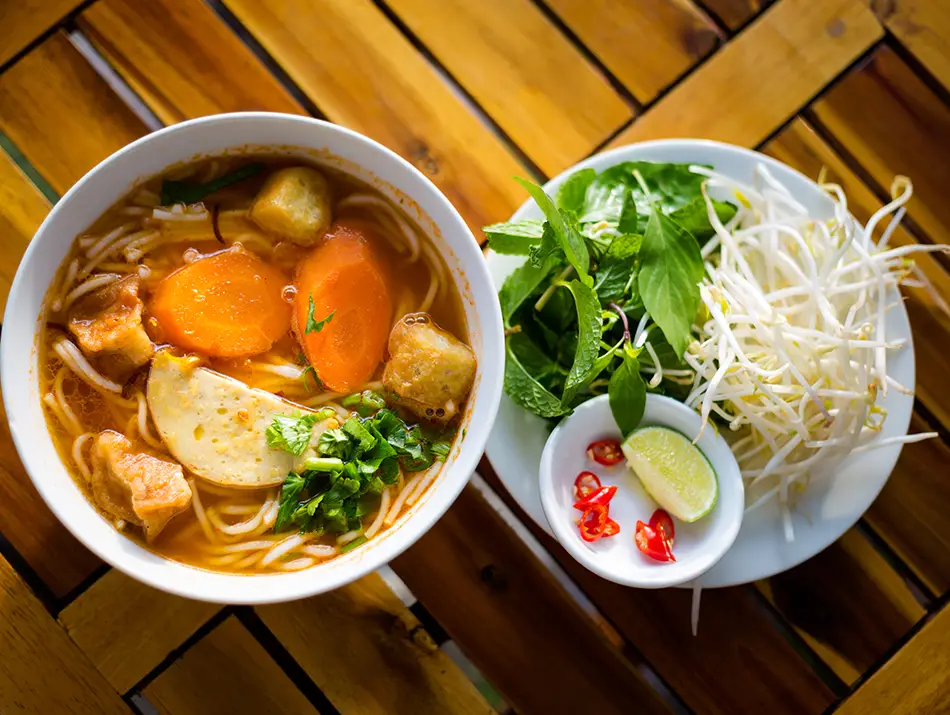
Hue’s culinary heritage is one of its greatest draws. The city was the seat of the Nguyen Dynasty, and its food reflects the complexity and refinement of the former royal court. You will find that the food to try in Hue is distinct from other regions in Vietnam.
- Bun Bo Hue: This is the city’s signature dish. It’s a rich and spicy beef noodle soup with a complex broth made from lemongrass, shrimp paste, and chili. It’s far more robust than pho and is a local breakfast staple.
- Banh Beo, Nam, Loc: This is a trio of steamed rice cakes, each with a unique texture and presentation. Banh Beo are small, steamed rice discs topped with dried shrimp and scallions. Banh Nam are flat rice dumplings filled with shrimp and pork, wrapped in banana leaves. Banh Loc are chewy tapioca dumplings, often filled with a whole shrimp.
- Nem Lui: This dish consists of grilled pork skewers wrapped around a stalk of lemongrass. To eat it, you wrap the pork in rice paper with fresh herbs, pickled vegetables, and a star fruit slice, then dip it in a savory peanut sauce.
- Banh Khoai: A crispy, savory pancake made from rice flour and turmeric, filled with pork, shrimp, and bean sprouts. It’s similar to the southern Banh Xeo but is smaller, thicker, and served with a distinct peanut-based dipping sauce.
Where to Find Best Restaurants in Hue
The best food in Hue is often found in small, unassuming local eateries rather than large, fancy restaurants. The area around Dong Ba Market is a fantastic place for street food, offering a huge variety of local snacks and dishes at low prices. It’s chaotic and authentic.
For a more relaxed dining experience, the streets of Vo Thi Sau and Nguyen Thai Hoc on the south bank are lined with restaurants catering to both locals and tourists, serving a range of Hue specialties.
To find truly non-touristy eateries, venture into the residential alleys (known as kiet) branching off the main roads. These hidden spots often serve the most authentic and delicious versions of local dishes.
Evenings and Nightlife in Hue: What to Do After Dark
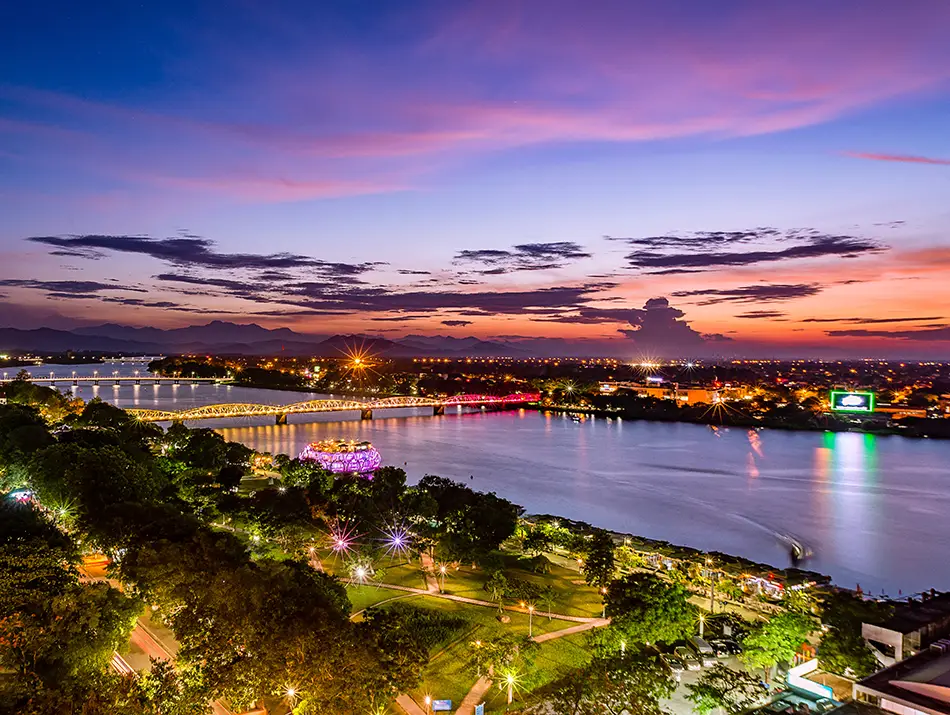
While Hue is quieter than Ho Chi Minh or Hanoi, its nightlife has expanded significantly for 2026. The city now balances its traditional “quiet” reputation with vibrant pedestrian zones and a growing craft beer scene.
Pedestrian Streets & Evening Walks
The Nguyen Dinh Chieu Walking Street remains the centerpiece of Hue’s riverside charm. Strolling along the Perfume River, you’ll find wooden kiosks selling traditional handicrafts and the Lim Wooden Bridge, which is illuminated and popular for photos. For a more modern vibe, head to the Hai Ba Trung Walking Street (opened in 2023), which features 3D light mapping on historic buildings and a “Cinema Street” atmosphere near the CineStar theater.
The “Western Quarter” (Phu Hoi)
For those seeking a livelier atmosphere, the intersection of Chu Van An, Vo Thi Sau, and Pham Ngu Lao streets forms the “Western Quarter.” This area is packed with bars, pubs, and late-night eateries. DMZ Bar (60 Le Loi) is a local landmark known for its expansive menu and rooftop view, while Brown Eyes Bar (56 Chu Van An) remains the primary spot for travelers looking to dance into the early hours.
Hue on a Budget
Hue is an exceptional destination for travelers looking to maximize their value. You can eat like a local at street food stalls and markets like Dong Ba, where a bowl of authentic Bun Bo Hue costs roughly 40,000 VND ($1.55 / €1.45)—often less than a coffee at a tourist-facing cafe.
Renting a bicycle for the day is an inexpensive way to explore the flat city streets and nearby villages. Many of Hue’s most serene sights remain free, including the iconic Thien Mu Pagoda, the Thien An Monastery nestled in pine hills, and the Thanh Toan Covered Bridge in the countryside.
For those visiting multiple major monuments, the 4-site Combo Ticket (Imperial City + 3 Tombs) costs 530,000 VND ($20.80 / €19.60) and is valid for two days, saving you roughly 25% over individual tickets.
Sustainable and Responsible Travel Tips

Hue is currently struggling to balance its “Net Zero 2025” goals with the 60 tons of plastic waste its residents and tourists generate every single day. The Perfume River is particularly vulnerable to microplastic pollution and urban runoff. To protect this former imperial capital from ecological and structural decline, travelers must adopt “Plastic Smart” habits and adhere to strict cultural protocols that prevent the accelerated wear of its 19th-century wooden heritage.
- Support Inclusive Employment at Hope Center: Visit this social enterprise that provides vocational training and jobs for people with disabilities and underprivileged women. You can purchase high-quality handicrafts or participate in a craft workshop, knowing your contribution directly supports social equity and sustainable livelihoods in the region.
- Bypass the Single-Use Loop: As part of the “Hue – A Plastic Smart City” initiative, the city has installed free public water stations at major sites including Thien Mu Pagoda, Bao Vinh Ancient Town, Half-Moon Bridge (Cau Ban Nguyet), and Vong Canh Hill. Use the (RefillMyBottle or mymizu) apps to find these and other participating eco-vendors.
- Utilize “Net Zero” Transport: Hue has launched Vietnam’s first ride-hailing cyclo service via a dedicated app, providing a regulated, non-motorized way to explore the Citadel. For travel to the outer Royal Tombs, book Xanh SM electric taxis or motorbikes to keep noise and air pollution out of the forest-shrouded mausoleums.
Critical Activities to Avoid
- Dressing Improperly at Sacred Sites: Hue maintains some of the strictest dress codes in Vietnam. You must cover your shoulders and knees at all Royal Tombs and Pagodas. Tank tops, shorts, and sheer fabrics are not allowed inside worshipping areas. Most sites, like Thien Mu Pagoda, provide or rent scarves at the entrance—carry your own to avoid the waste and cost of temporary rentals.
- Tipping for Exploitative Rituals: Avoid participating in or tipping for “merit release” at Thien Mu Pagoda, where birds or fish are sold to be set free. These animals are often caught specifically for this ritual and frequently die or are recaptured immediately after, fueling a cycle of poaching.
- Unregulated Lantern Releases on the Perfume River: While traditional, most river lanterns use metal frames or plastic components that sink and pollute the riverbed. If you participate, ensure the lantern is 100% biodegradable and released in areas where official cleanup teams operate.
Know Before You Go
Accessibility
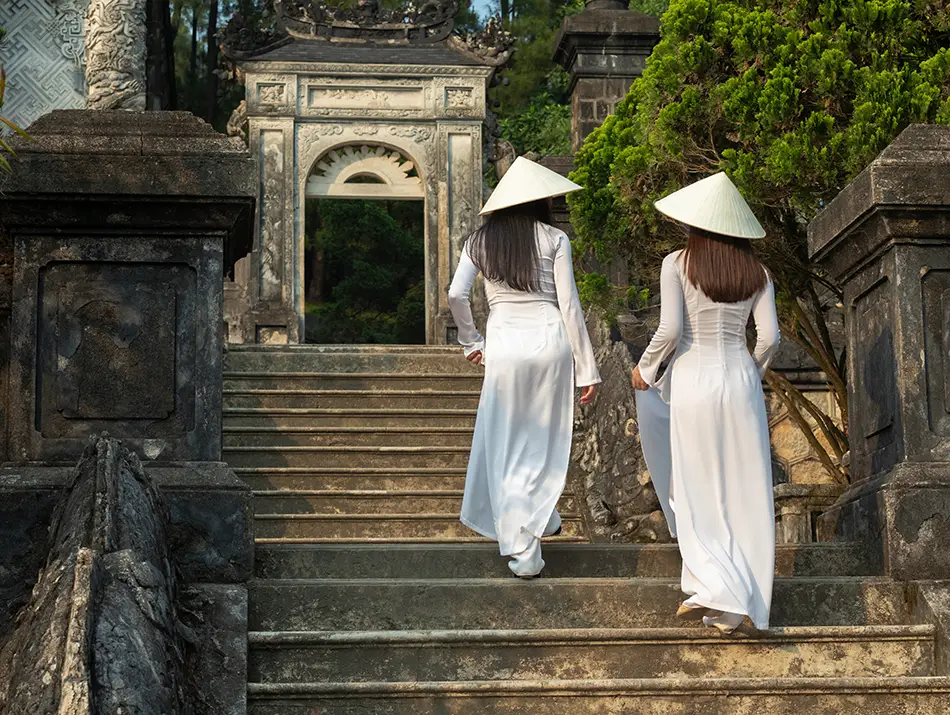
Hue has made significant strides in accessibility. The Imperial City now features a primary accessible route with ramps at main entrances. However, the Royal Tombs remain a challenge; Khai Dinh Tomb is built into a steep hillside with over 100 steps, and Tu Duc Tomb has many uneven stone paths. Most 2026-era hotels in the city center are equipped with elevators and ramps, but the historic “Citadel” district still has many high-threshold entries. For the best experience, hire a private vehicle through apps like Grab (selecting the “GrabCar” option) or a local driver who can assist with entry and exit.
Family with Kids
Hue is a “living history” museum that is surprisingly kid-friendly in 2026. Beyond the vast courtyards of the Citadel—which are perfect for burning off energy—children can enjoy the 3D digital mapping shows at the Hai Ba Trung Walking Street.
- Swimming: The humidity in Hue can be intense from May to August. It is highly recommended to book a hotel with a pool to allow for a midday cooling-off break.
- Interactive Crafts: Visit the Thanh Tien Paper Flower Village or Thuy Xuan Incense Village, where artisans host 30-minute workshops specifically designed for children to get hands-on with local dyes and bamboo.
Without the Hype: Is Hue Worth Visiting?
Hue offers a profound look into Vietnam’s imperial history and a world-class culinary scene, but its unhurried pace and focus on heritage aren’t for every traveler. It trades the neon bustle of larger cities for a contemplative, poetic atmosphere.
You’ll like Hue if:
- You are a dedicated foodie: You want to explore the “cradle” of Vietnamese cuisine, from street-level Com Hen to 8-course royal banquets.
- You value sustainability: You appreciate a city that prioritizes “green” transport and is an official ASEAN Clean Tourist City.
- You are a history enthusiast: The ongoing restoration of sites like the Kien Trung Palace (reopened in late 2024) provides a high-definition look at royal life.
You might skip it if:
- You want a party-centric vacation: While the Phu Hoi backpacker district and Hai Ba Trung Walking Street offer lively nights, Hue is not an all-night clubbing destination.
- You are seeking adventure sports: Apart from trekking in Bach Ma National Park, Hue is more about “soft” exploration than high-adrenaline activities.
- You have very limited time: If you only have 48 hours in Vietnam, the sprawling nature of the tombs and citadel may feel too time-consuming compared to more compact destinations.
Good alternatives:
- For ancient charm and social vibes: Hoi An Ancient Town offers a more compact, visually vibrant experience with a significantly more active evening social scene and easy beach access.
- For a modern beach holiday: Da Nang offers a sleek skyline, luxury resorts, and a more “vacation-ready” infrastructure for families.
We hope this guide on the best things to do in Hue has helped you decide whether this historic city fits your travel interests.
For more inspiration, explore the full collection of Vietnam travel guides on our website. We wish you easy planning and an unforgettable trip.